All posts by weblio PH

Eiken 2_1

DIRECTIONS

Read the passage silently for 20 seconds. Then, read the passage aloud in 1 minute starting from the title.

READ

Owning a Pet

Nowadays, a lot of people are very fond of having pets at home. The most common pets around the world are cats and dogs. Some people also like small animals like hamsters and rabbits. Owning a pet can be done by buying at a pet shop. Some people go to such shops and buy pets, and by doing so they can have their own pets.

QUESTION 1

Please look at the passage.
According to the passage, how can people have their own pets?

ANSWER

QUESTION 2

Please look at the pictures and describe the situation.
Describe each picture in 2 sentences.

 
Your story should start with the following sentence:
One day, Yuki was talking to her father about having a pet.

ANSWER

Eiken 2_1

1st picture:
One day, Yuki was talking to her father about having a pet.
____________________________________________________________.
2nd picture:
____________________________________________________________.
____________________________________________________________.
3rd picture:
____________________________________________________________.
____________________________________________________________.

QUESTION 3

Now, I will ask you the following question. Please give 2 reasons to support your answer.
Some people say that it is okay to use animals for research purposes.
What do you think about that?

ANSWER

I agree/disagree ____________________________________________________________.
_______________________________________________________________________________.


QUESTION 4

Now, I will ask you another question. Please give 2 reasons to support your answer.
These days, many people prefer to retire abroad than in their home country.
Do you think this is a good idea?

ANSWER

Yes/No ______________________________________________________________________.
_______________________________________________________________________________.

Conversation(Intermediate Chapter 2)|日常会話(中級2章)
Lesson29: Art and Literature 芸術と文学

LESSON GOAL

Let’s check our lesson goal.
In this material, you will learn the words and phrases when talking about art and literature and express your opinions about specific topics.

PART A_1

Rearrange the letters of the words to complete each sentence. Read the meanings aloud and use them as clues.
ANSWERS
  1. mundane
  2. originated
  3. scenic

PART A_2

1. word:
M
N
U
D
A
E
N
meaning: [adjective] ordinary and not interesting
sentence: For some people, painting is a _______ activity.
2. word:
O
I
R
I
G
A
T
N
E
D
meaning: [verb] where it began/started
sentence: Ballet dance _______ in 15th century Italy.
3. word:
S
E
C
N
I
C
meaning: [adjective] a beautiful sight
sentence: Her painting collection consists of _______ views in South America.

PART B_1

Let’s read the dialogue. I will be Sam and you will be Alice. Fill in the blanks with your own responses.

PART B_2

I thought classes are suspended tomorrow due to bad weather. Why don’t you take a little break from studying?
This is my final term project, brother. I’m writing a literature review of The Tale of Genji. It is the greatest novel in Japan and the world’s first novel. Do you know about it?

Of course, I studied it for my eighth-grade literature class. Although, I find reading a mundane activity. Do you like reading, sister?
___________________. How about you? I think you’re into visual art.

I am. I love painting scenic views and doing portraits. I like the impressionist style of painting. By the way, do you have a favorite art style?
___________________.

I see. Well, I hope you’ll be able to finish your homework on time. If you need any help, you know where to find me.
Sure. Thanks, brother.

PART C_1

Read the article and take note of the important points.

PART C_2

Every seventh of July, Japan celebrates one of their famous festivals known as “Tanabata”, the Star Festival. It is known to have originated from China’s “Qixi Festival”. It was first introduced in Japan in 755 A.D. by Empress Koken, the 48th monarch of Japan. The Japanese fully embraced Tanabata Festival and its story during the early Edo period. Tanabata is a story of two lovers, Hikoboshi and Orihime, who were only allowed to see each other once a year as a punishment given to them by the heaven god for neglecting their duties after marrying each other. Today, Japan’s streets are in vibrant displays with people writing their wishes on strips of paper known as “Tanzaku”. They hang these strips of paper on bamboo trees with hopes that their wishes will come true. In some traditions, these bamboo trees are set afloat on a river and/or burned once the festival is over.

PART C_3

Please answer the questions about the article.

PART C_4

1. Who are the two lovers celebrated at the Tanabata Festival?
Answer:
2. Why are the two lovers not allowed to spend their life together?
Answer:
3. Some people say that the Tanabata Festival is equivalent to Valentine’s Day. Do you agree or disagree?
Answer:
4. What do you think will happen to a country without art and literature?
Answer:

PART D_1

In your own understanding, please explain the meaning of the following quotations.

PART D_2

1. “Creativity takes courage.” – Henry Matisse
Answer:
2. “It takes a great deal of history to produce a little literature.” – Henry James
Answer:

PART E_1

Let’s talk. Please answer my questions.

PART E_2

1. Who is your favorite literary character?
Answer:
2. What is the weirdest literature you have read?
Answer:
3. Do you prefer fiction or non-fiction literature?
Answer:
4. Which art form do you like most?
Answer:
5. Do you think art is important in the modern world? How?
Answer:

REVIEW AND FEEDBACK

Now, let us review what you learned in this lesson.
(Please give short feedback on how your student did in your class.)
Grammar
文法
Pronunciation
発音
Vocabulary
単語
Comprehension
理解
GOOD 文法の誤りはほとんどなく、完全な文章で話すことができる ほとんどの単語をはっきりと正しく発音することができる 習った表現を適切に使うことができる 文章を理解し、質問に正しく答えることができる

FAIR
文法の誤りはあるが、完全な文章で話すことができる 発音の練習が必要な言葉がいくつかある たまにミスはあるが、習った表現を適切に使うことができる 文章を完全に理解するのは難しく、質問に正しく答えられないときもある

POOR
文章で話すのは難しく、単語だけで話すことができる 発音の練習が必要である 習った単語と表現を少しだけ使うことができる 文章を理解するのは難しく、質問に答えるのは難しい
TUTOR FEEDBACK

GRAMMAR
Good: Was able to speak in complete sentences with minimal grammatical errors.
Fair: Was able to speak in complete sentences with evident grammatical errors.
Poor: Was able to speak using words only.
PRONUNCIATION
Good: Was able to pronounce most of the words clearly and correctly.
Fair: Mispronounced a few words.
Poor: Mispronounced most of the words.
VOCABULARY
Good: Used appropriate expressions learned in class.
Fair: Used appropriate expressions learned in class and made a few errors in word choice.
Poor: Used only a few words and expressions.
COMPREHENSION
Good: Was able to understand the passages and answer the questions correctly.
Fair: Had a little difficulty in understanding passages and answering questions.
Poor: Had a hard time understanding passages and answering questions.

Conversation(Intermediate Chapter 2)|日常会話(中級2章)
Lesson28: History and Culture 歴史と文化

LESSON GOAL

Let’s check our lesson goal.
In this material, you will learn the words and phrases when talking about
history and culture and express your opinions about specific topics.

PART A_1

Rearrange the letters of the words to complete each sentence. Read the meanings aloud and use them as clues.
ANSWERS
  1. remarkable
  2. civilization
  3. expedition

PART A_2

1. word:
R
M
E
R
A
A
K
L
B
E
meaning: [adjective] someone or something unusual, impressive, or worthy of attention
sentence: Her research on the ancient kingdom is truly ______________.
2. word:
C
V
I
I
L
Z
I
T
A
O
I
N
meaning: [noun] a human society with developed culture, laws, and intellect at a specific time and place
sentence: The Mayan ________________ was famous for its calendar-making, symbolic artwork, and agriculture.
3. word:
E
X
E
P
I
D
T
O
I
N
meaning: [noun] an organized journey, especially a long one for a particular purpose
sentence: He was famous for leading an _______________ around the world.

PART B_1

Let’s read the dialogue. I will be Ron and you will be Emma. Fill in the blanks with the correct responses.

PART B_2

I couldn’t sleep last night, so I searched for information about world history on the internet. I didn’t expect world history to be so interesting. What do you think is the most remarkable historical event?
________________________________. What about you?

I’ve been reading about Japanese history lately and I found out about Onna-Bugeisha. Do you know about them?
I know about them because I’ve read about Japanese history. They were female warriors in ancient Japan. According to some historical accounts, Empress Jingu is considered one of the earliest Onna-Bugeisha.

Cool! Onna-Bugeisha even fought alongside samurai during battles. By the way, I think the greatest civilization was the Mesopotamian civilization. People in this era built waterways to support their economic activities. What do you think was the greatest civilization in history?
_________________________.


That’s incredible. It was silly of me to think history was boring when I was in high school.
It’s amazing how history has shaped us into what we are today.
I’m excited to see what the future holds for us all.

PART C_1

Read the article and note the important points.

PART C_2

Alexander the Great is widely known as a famous military leader and conqueror. He greatly influenced the world in less than two decades. At a young age, Alexander was educated by a famous philosopher, Aristotle. After the death of his father, he became king at age twenty. He then expanded his army, developed new battle techniques, and led his forces in conquering the Persian Empire. His conquests led him to victories not just in Persian territories but also in Syria, Egypt, and Asia Minor. His conquests also helped spread Greek culture throughout these territories. Because of his successful expeditions, Greek culture spread to many territories.

PART C_3

Please answer the questions about the article.

PART C_4

1. At what age did Alexander the Great become king?
Answer:
2. Based on the article, what were some of Alexander the Great’s achievements?
Answer:
3. Some people say that history repeats itself. Do you agree or disagree?
Answer:
4. How did Alexander the Great help spread Greek culture?
Answer:

PART D_1

In your own understanding, please explain the meaning of the following quotations.

PART D_2

1. “We are not makers of history. We are made by history.” – Martin Luther King, Jr.
Answer:
2. “Yesterday is history, tomorrow is a mystery, but today is a gift. That’s why it is called the present.” – Master Oogway
Answer:

PART E_1

Let’s talk. Please answer my questions.

PART E_2

1. What do you think are humanity’s greatest achievements and worst failures?
Answer:
2. What historical invention or cultural development do you find most interesting?
Answer:
3. Which do you think is most important: the past, the present, or the future?
Answer:
4. What historical event would you like to turn into a movie? Do you think it’s important for the movie to be historically accurate?
Answer:
5. If you had the power to travel back in time, what historical period would you like to visit? Why?
Answer:

REVIEW AND FEEDBACK

Now, let us review what you learned in this lesson.
(Please give short feedback on how your student did in your class.)
Grammar
文法
Pronunciation
発音
Vocabulary
単語
Comprehension
理解
GOOD 文法の誤りはほとんどなく、完全な文章で話すことができる ほとんどの単語をはっきりと正しく発音することができる 習った表現を適切に使うことができる 文章を理解し、質問に正しく答えることができる

FAIR
文法の誤りはあるが、完全な文章で話すことができる 発音の練習が必要な言葉がいくつかある たまにミスはあるが、習った表現を適切に使うことができる 文章を完全に理解するのは難しく、質問に正しく答えられないときもある

POOR
文章で話すのは難しく、単語だけで話すことができる 発音の練習が必要である 習った単語と表現を少しだけ使うことができる 文章を理解するのは難しく、質問に答えるのは難しい
TUTOR FEEDBACK

GRAMMAR
Good: Was able to speak in complete sentences with minimal grammatical errors.
Fair: Was able to speak in complete sentences with evident grammatical errors.
Poor: Was able to speak using words only.
PRONUNCIATION
Good: Was able to pronounce most of the words clearly and correctly.
Fair: Mispronounced a few words.
Poor: Mispronounced most of the words.
VOCABULARY
Good: Used appropriate expressions learned in class.
Fair: Used appropriate expressions learned in class and made a few errors in word choice.
Poor: Used only a few words and expressions.
COMPREHENSION
Good: Was able to understand the passages and answer the questions correctly.
Fair: Had a little difficulty in understanding passages and answering questions.
Poor: Had a hard time understanding passages and answering questions.

Eiken 2_4

DIRECTIONS

Read the passage silently for 20 seconds. Then, read the passage aloud in 1 minute starting from the title.

READ

Online Jobs

Nowadays, some people choose to work from home rather than work in an office. Some of them do online jobs like writing articles, creating websites, and making designs. They can choose what tasks to do. They can decide when and where to work as well. Some people have these jobs, and in this way they can spend more time for other things aside from work.

QUESTION 1

Please look at the passage.
According to the passage, how can some people spend more time for other things aside from work?

ANSWER

QUESTION 2

Please look at the pictures and describe the situation.
Describe each picture in 2 sentences.

 
Your story should start with the following sentence:
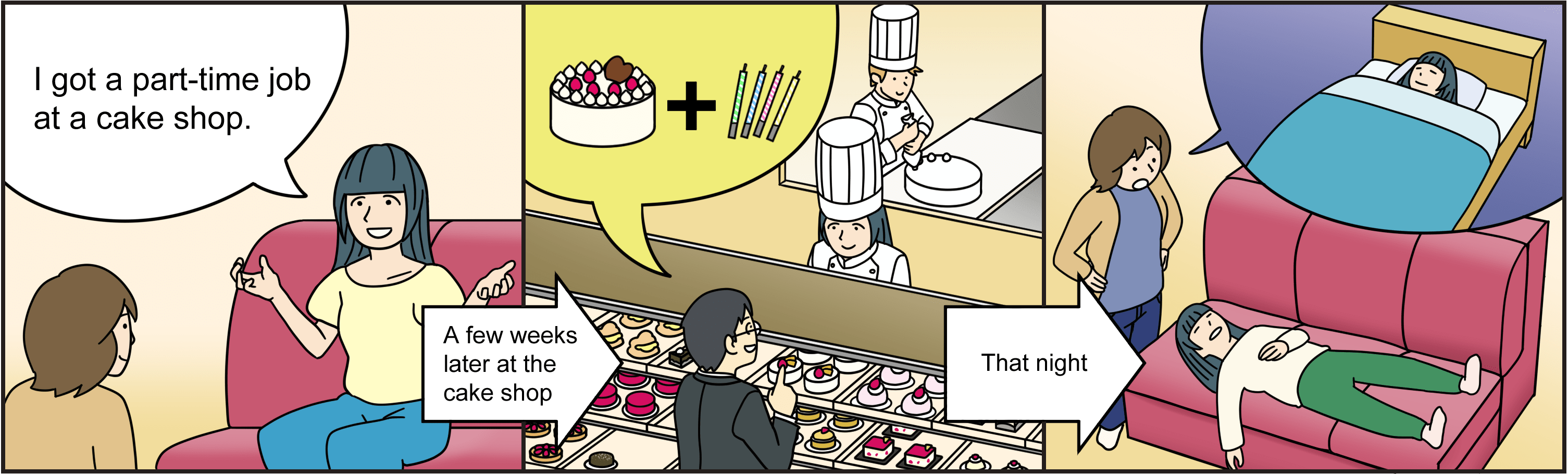
One day, Ami was talking to her mother about her part-time job.

PICTURE

Eiken 2_4

1st picture:
One day, Ami was talking to her mother about her part-time job.
____________________________________________________________.
2nd picture:
____________________________________________________________.
____________________________________________________________.
3rd picture:
____________________________________________________________.
____________________________________________________________.

QUESTION 3

Now, I will ask you the following question. Please give 2 reasons to support your answer.
Some people say that working part-time helps students become more responsible.
What do you think about that?

ANSWER

I agree/disagree ____________________________________________________________.
_______________________________________________________________________________.

QUESTION 4

Now, I will ask you another question. Please give 2 reasons to support your answer.
These days, many people prefer text messages over phone calls.
Do you think this is a good idea?

ANSWER

Yes/No ______________________________________________________________________.
_______________________________________________________________________________.

Conversation(Intermediate Chapter 2)|日常会話(中級2章)
Lesson27: Traveling 旅行

LESSON GOAL

Let’s check our lesson goal.
In this material, you will learn words that you can use to talk about traveling and tourism and express your opinions about specific topics.

PART A_1

Rearrange the letters of the words to complete each sentence. Read the meanings aloud and use them as clues.
ANSWERS
  1. exotic
  2. tranquil
  3. overcrowded

PART A_2

1. word:
E
O
X
I
T
C
meaning: [adjective] rare or uncommon
sentence: They were amazed when they saw ________ animals at the zoo.
2. word:
T
A
R
N
U
I
Q
L
meaning: [adjective] peaceful and quiet
sentence: The temple they visited was beautiful and ________.
3. word:
O
E
V
R
C
R
W
O
D
E
D
meaning: [adjective] containing too many people or things
sentence: Some tourist places in Japan are becoming ________.

PART B_1

Let’s read the dialogue. I will be Ron and you will be Emma. Fill in the blanks with the correct responses.

PART B_2

We have a long weekend next week and I’m planning to take a mini-vacation. Do you have any suggestions for where I can travel and unwind?
_______________________. What is your ideal travel destination?

Well, I want to go to places that are quite exotic and tranquil. How about you?
_______________________.

I didn’t know you were into traveling, too. Maybe one day we can be travel buddies and explore together. How often do you travel, by the way? And do you travel alone?
I actually prefer traveling alone since I enjoy having some time
for myself. However, I still travel with my family or friends depending
on the destination. I usually travel once or twice a month.


That’s amazing. I’m also thinking of making travel videos whenever I travel, so I can keep memories of my trips.
That sounds like a good idea. I think I should start making travel videos, too.

PART C_1

Read and take note of the main points in the article.

PART C_2

According to an article in a British newspaper, an international tourism organization declared Japan the world’s fastest-growing tourist destination since 2010, followed by India, Vietnam, and Thailand. Because of the country’s exotic destinations and tranquil tourist spots, Japan has attracted many international visitors. Some of Japan’s most visited places are Shibuya, Dotonbori, and a popular theme park in Tokyo.
However, according to a Japanese newspaper, Japan is starting to face a problem known as “Kankō Kōgai,” which means “tourism pollution,” due to overcrowding, especially in large cities and major tourist destinations. Some local residents are getting stressed by the uncontrolled rise in the number of tourists every day. Local residents are calling for better transportation services and more accommodations for tourists to address this problem.

PART C_3

Please answer the questions about the article.

PART C_4

1. Which organization declared Japan the world’s fastest-growing tourist destination?
Answer:
2. In your own words, what is tourism pollution?
Answer:
3. What are some possible effects of having too many tourists at popular destinations?
Answer:
4. What could tourist destinations do to reduce “Kankō Kōgai” without negatively affecting tourism?
Answer:

PART D_1

In your own words, please explain the meaning of the following quotations.

PART D_2

1. “Even if traveling is not for everyone, don’t be afraid to explore. Life is too short, so go and see the world.” – Unknown
Answer:
2. “It’s not about how much you spend on traveling. It’s about the memories you make and the experiences you gain while traveling.” – Unknown
Answer:

PART E_1

Let’s talk. Please answer my questions. You may ask questions, too.

PART E_2

1. If you were to live in another country, where would it be and why?
Answer:
2. What do you think is the most remarkable place on Earth?
Answer:
3. Have you ever gotten lost while traveling?
Answer:
4. What place do you like to visit again and again, either in your country or abroad?
Answer:
5. Describe your ideal vacation with family or friends.
Answer:

REVIEW AND FEEDBACK

Now, let us review what you learned in this lesson.
(Please give short feedback on how your student did in your class.)
Grammar
文法
Pronunciation
発音
Vocabulary
単語
Comprehension
理解
GOOD 文法の誤りはほとんどなく、完全な文章で話すことができる ほとんどの単語をはっきりと正しく発音することができる 習った表現を適切に使うことができる 文章を理解し、質問に正しく答えることができる

FAIR
文法の誤りはあるが、完全な文章で話すことができる 発音の練習が必要な言葉がいくつかある たまにミスはあるが、習った表現を適切に使うことができる 文章を完全に理解するのは難しく、質問に正しく答えられないときもある

POOR
文章で話すのは難しく、単語だけで話すことができる 発音の練習が必要である 習った単語と表現を少しだけ使うことができる 文章を理解するのは難しく、質問に答えるのは難しい
TUTOR FEEDBACK

GRAMMAR
Good: Was able to speak in complete sentences with minimal grammatical errors.
Fair: Was able to speak in complete sentences with evident grammatical errors.
Poor: Was able to speak using words only.
PRONUNCIATION
Good: Was able to pronounce most of the words clearly and correctly.
Fair: Mispronounced a few words.
Poor: Mispronounced most of the words.
VOCABULARY
Good: Used appropriate expressions learned in class.
Fair: Used appropriate expressions learned in class and made a few errors in word choice.
Poor: Used only a few words and expressions.
COMPREHENSION
Good: Was able to understand the passages and answer the questions correctly.
Fair: Had a little difficulty in understanding passages and answering questions.
Poor: Had a hard time understanding passages and answering questions.

Conversation(Intermediate Chapter 2)|日常会話(中級2章)
Lesson26: News and Press Media Newsと報道メディア

LESSON GOAL

Let’s check our lesson goal.
In this material, you will learn words that you can use when talking about news media and express your opinions about specific topics.

PART A_1

Rearrange the letters of the words to complete each sentence. Read the meanings aloud and use them as clues.
ANSWERS
  1. misleading
  2. biased
  3. violent

PART A_2

1. word:
M
S
I
E
L
A
I
D
N
G
meaning: [adjective] giving the wrong idea or impression
sentence: The news headline is ____________.
2. word:
B
A
I
E
S
D
meaning: [adjective] unfairly supporting or opposing something
sentence: The news report was ________ in favor of one side.
3. word:
V
O
I
E
L
N
T
meaning: [adjective] harmful and destructive
sentence: The news anchor reported the ___________ storm that hit the major city last night.

PART B_1

Let’s read the dialogue. I will be Ron and you will be Emma. Fill in the blanks with the correct responses.

PART B_2

I can’t stand watching today’s news, Emma. They’re mostly depressing. I feel like bad news always travels faster than good news. Has there been any good news recently?
_____________________________. Nonetheless, you should still watch the news to keep yourself updated on what’s happening around you.

Don’t worry, I still do. However, I prefer to watch news features and documentaries because they’re not that violent. What’s the best news you’ve heard so far?
_________________________________________

That’s nice. I hope news outlets will become less biased and stick more to the truth. By the way, do you know how to tell whether the news is biased or not?
I watch, read, and listen to news critically. Sometimes, even just by
reading and understanding the headlines, you will know if the news is
biased or not. I always watch out for misleading sentences, one-sided
reports, and opinionated terms.


You’re absolutely right. Nowadays, it’s easy for fake news to spread, so we need to be very careful about what we believe and what we share with others.
Indeed. It’s our duty as citizens to be responsible and observant.

PART C_1

Read the article and note the important points.

PART C_2

The history of news dates back to Ancient Rome and the Han Dynasty in China. In Ancient Rome, “Acta Diurna,” or government announcements, were engraved either on metal or stone before being posted in public places. Meanwhile, in China, news sheets were handwritten on silk. In 1456, a movable printing system was invented by a German blacksmith, Johannes Gutenberg. Since then, important information became easier to share with everyone. Misleading information could also spread more widely.
A hundred years later, the term “newspaper” was first used in Venice, Italy, when the government published its first handwritten newsletters known as “Written Notice”. To this day, news plays an important role in educating and updating the public and continues to shape the modern world. News can be biased, and some reports may cover violent events.

PART C_3

Answer the questions about the article.

PART C_4

1. Who invented the first movable printing system?
Answer:
2. Based on the article, how does news shape the modern world?
Answer:
3. Some people say that other sources of information could replace traditional news media. Do you agree or disagree?
Answer:
4. What do you think would happen if anyone (including those without a professional background in journalism) wrote and published news?
Answer:

PART D_1

In your own words, please explain the meaning of the following quotes.

PART D_2

1. “News is the bridge between people and the world.”
– Unknown
Answer:
2. “A newspaper is not just for reporting the news as it is, but also for encouraging people to think about it.”
– Mark Twain
Answer:

PART E_1

Let’s talk. Please answer my questions.

PART E_2

1. Do you think there is more bad news than good news nowadays?
Answer:
2. Would you consider becoming a news reporter if you had the chance?
Answer:
3. What kind of news interests you the most?
Answer:
4. Should news be more entertaining than informative?
Answer:
5. If you were featured in the news, what would the headline be?
Answer:

REVIEW AND FEEDBACK

Now, let us review what you learned in this lesson.
(Please give short feedback on how your student did in your class.)
Grammar
文法
Pronunciation
発音
Vocabulary
単語
Comprehension
理解
GOOD 文法の誤りはほとんどなく、完全な文章で話すことができる ほとんどの単語をはっきりと正しく発音することができる 習った表現を適切に使うことができる 文章を理解し、質問に正しく答えることができる

FAIR
文法の誤りはあるが、完全な文章で話すことができる 発音の練習が必要な言葉がいくつかある たまにミスはあるが、習った表現を適切に使うことができる 文章を完全に理解するのは難しく、質問に正しく答えられないときもある

POOR
文章で話すのは難しく、単語だけで話すことができる 発音の練習が必要である 習った単語と表現を少しだけ使うことができる 文章を理解するのは難しく、質問に答えるのは難しい
TUTOR FEEDBACK

GRAMMAR
Good: Was able to speak in complete sentences with minimal grammatical errors.
Fair: Was able to speak in complete sentences with evident grammatical errors.
Poor: Was able to speak using words only.
PRONUNCIATION
Good: Was able to pronounce most of the words clearly and correctly.
Fair: Mispronounced a few words.
Poor: Mispronounced most of the words.
VOCABULARY
Good: Used appropriate expressions learned in class.
Fair: Used appropriate expressions learned in class and made a few errors in word choice.
Poor: Used only a few words and expressions.
COMPREHENSION
Good: Was able to understand the passages and answer the questions correctly.
Fair: Had a little difficulty in understanding passages and answering questions.
Poor: Had a hard time understanding passages and answering questions.

Conversation(Intermediate Chapter 2)|日常会話(中級2章)
Lesson25: Spending and Consumerism 消費と消費者運動

LESSON GOAL

Let’s check our lesson goal.
In this material, you will learn words that you can use when talking about spending and consumerism and express your opinions about specific topics.

PART A_1

Rearrange the letters of the words to complete each sentence. Read the meanings aloud and use them as clues.
ANSWERS
  1. allowance
  2. conscious
  3. thrifty

PART A_2

1. word:
A
L
O
L
A
W
N
C
E
meaning: [noun] an amount of money given regularly for personal use
sentence: He promised to save twenty percent of his _____________ so that he could buy a new car.
2. word:
C
N
O
C
S
I
U
O
S
meaning: [adjective] aware of what one is doing or how one is behaving
sentence: Her mother is _______________ of how she spends the family’s monthly budget.
3. word:
T
H
I
R
T
F
Y
meaning: [adjective] using money carefully and not wastefully
sentence: I need to be ___________ so I can save enough money for a new car.

PART B_1

Let’s read the dialogue. I will be Alice and you will be Sam. Fill in the blanks with appropriate responses.

PART B_2

I used up all my weekly allowance yesterday. May I borrow 100 dollars, sister?
____________. Where did you spend all your money?

There was a big sale at the mall. I couldn’t resist, so I went shopping with my friends. I didn’t realize that I had no money left until I got home last night.
I won’t blame you, but you should’ve been a conscious shopper. Money doesn’t come by so easily these days.

I know, I’m sorry. Do you have any advice so I can become thrifty like you?
________________________________________.

I’m not sure if I can follow all of your advice, but I will try my best. Thanks, sister.
No problem. Anyway, here’s 100 dollars.

PART C_1

Read and take note of the important points in the article.

PART C_2

In Japan, there is a money-saving method known as “kakeibo,” which means “household financial ledger.” Kakeibo was created and first published in a women’s magazine by a female journalist in 1995. It is an annual journal composed of spreadsheets and inspirational messages that motivate users to manage their finances. The journal helps users keep track of how much they spend and earn, although its main goal is to help them save more money. Using kakeibo can help consumers become more responsible with their money. In addition, a financial blogger suggested that parents should teach their kids how to save money by placing cash gifts they receive during holidays and special occasions in the bank.

PART C_3

Please answer the questions about the article.

PART C_4

1. What is kakeibo?
Answer:
2. How do parents teach their children to save money?
Answer:
3. Financial education should be taught to young children at school. Do you agree or disagree?
Answer:
4. What do you think will happen if a majority of people are overspending?
Answer:

PART D_1

In your own words, please explain the meaning of the following quotations.

PART D_2

1. “Beware of little expenses. A small leak will sink a great ship.” – Benjamin Franklin
Answer:
2. “When you have money, think of the time when you had none.” – a Japanese proverb
Answer:

PART E_1

Let’s talk. Please answer my questions.

PART E_2

1. What is the most expensive thing you have ever bought without much thought?
Answer:
2. Imagine you earned a lot of money. What would you spend it on and why?
Answer:
3. What advice can you give to people who are overspending?
Answer:
4. If you were to remove some expenses from your budget, what would they be?
Answer:
5. Name other ways to save money without depriving yourself.
Answer:

REVIEW AND FEEDBACK

Now, let us review what you learned in this lesson.
(Please give short feedback on how your student did in your class.)
Grammar
文法
Pronunciation
発音
Vocabulary
単語
Comprehension
理解
GOOD 文法の誤りはほとんどなく、完全な文章で話すことができる ほとんどの単語をはっきりと正しく発音することができる 習った表現を適切に使うことができる 文章を理解し、質問に正しく答えることができる

FAIR
文法の誤りはあるが、完全な文章で話すことができる 発音の練習が必要な言葉がいくつかある たまにミスはあるが、習った表現を適切に使うことができる 文章を完全に理解するのは難しく、質問に正しく答えられないときもある

POOR
文章で話すのは難しく、単語だけで話すことができる 発音の練習が必要である 習った単語と表現を少しだけ使うことができる 文章を理解するのは難しく、質問に答えるのは難しい
TUTOR FEEDBACK

GRAMMAR
Good: Was able to speak in complete sentences with minimal grammatical errors.
Fair: Was able to speak in complete sentences with evident grammatical errors.
Poor: Was able to speak using words only.
PRONUNCIATION
Good: Was able to pronounce most of the words clearly and correctly.
Fair: Mispronounced a few words.
Poor: Mispronounced most of the words.
VOCABULARY
Good: Used appropriate expressions learned in class.
Fair: Used appropriate expressions learned in class and made a few errors in word choice.
Poor: Used only a few words and expressions.
COMPREHENSION
Good: Was able to understand the passages and answer the questions correctly.
Fair: Had a little difficulty in understanding passages and answering questions.
Poor: Had a hard time understanding passages and answering questions.

Conversation(Intermediate Chapter 2)|日常会話(中級2章)
Lesson24: Traffic and Transportation 交通と乗り物

LESSON GOAL

Let’s check our lesson goal.
In this material, you will learn words that you can use when talking about traffic and transportation and express your opinions about specific topics.

PART A_1

Rearrange the letters of the words to complete each sentence. Read the meanings aloud and use them as clues.
ANSWERS
  1. hazards
  2. regulation
  3. pedestrian

PART A_2

1. word:
A
H
Z
A
R
D
S
meaning: [noun] things that are dangerous or can cause harm
sentence: Be aware of the traffic ___________ when driving on a slippery road.
2. word:
R
E
G
A
U
L
T
I
O
N
meaning: [noun] an official rule or law
sentence: The people in Metrovalle City have no regard for traffic __________.
3. word:
E
P
D
E
S
R
T
I
A
N
meaning: [noun] a person crossing the street
sentence: He almost hit the _________.

PART B_1

Let’s read the dialogue. I will be Sam and you will be Alice. Fill in the blanks with the correct responses.

PART B_2

I failed my driving and road tests earlier. I will retake my exams next week. What should I do?
Let’s see. How familiar are you with street signs and traffic hazards?

Not quite. Actually, those are the main reasons why I didn’t pass. I don’t know much about them.
I see. Well, the golden rule is to watch out for cyclists and pedestrians crossing the road. You must also pay attention to the speed limit. Some roads are busier than others.

I’ll keep that in mind. Can you tell me more about other traffic regulations?
_________________________________________.

That’s a lot, but I’ll make sure to remember all of that. Do you think I’ll pass my driving and road tests next week?
__________. Don’t be so nervous. Just remember that it is mandatory to obey traffic rules whether you’re a pedestrian or a driver.

PART C_1

Read and take note of the important points in the article.

PART C_2

According to This Is Insider, an online news media company, Tokyo is the most populated city on Earth and has the busiest pedestrian crossings in the world. Every day, at least 3,000 people cross at the famous Shibuya Crossing. Despite being overly crowded, everyone is polite and disciplined when crossing the streets even when the traffic lights change every two minutes. It is also home to one of Tokyo’s busiest train stations, which serves more than 2.4 million passengers a day. Shibuya Station began operating in 1885. Shibuya has also made its way to Hollywood films like The Fast and the Furious: Tokyo Drift and Resident Evil: Afterlife.

PART C_3

Please answer the questions about the article.

PART C_4

1. When did Shibuya Station first begin operating?
Answer:
2. Why do you think Shibuya Crossing is one of the busiest pedestrian crossings in the world?
Answer:
3. Road accidents happen more often at bigger pedestrian crossings than at smaller ones. Do you agree or disagree?
Answer:
4. What do you think will happen if train operations stop for a day?
Answer:

PART D_1

In your own words, please explain the meaning of the following quotations.

PART D_2

1. “The driver on the highway is safe not when he reads the signs, but when he obeys them.” – Aiden Wilson Tozer
Answer:
2. “Take it easy on driving. The life you save may be mine.” – James Dean
Answer:

PART E_1

Let’s talk. Please answer my questions.

PART E_2

1. What would you do if you suddenly saw a road accident and you were the only person in the area?

Answer:
2. Do you prefer driving your own car or commuting by public transportation?
Answer:
3. Aside from fines, what other measures can you think of to punish reckless drivers?
Answer:
4. What can you suggest to countries that experience heavy traffic?
Answer:
5. Some people say that elderly people, pregnant women, and persons with disabilities should not go out without someone accompanying them. Do you agree or disagree?
Answer:

REVIEW AND FEEDBACK

Now, let us review what you learned in this lesson.
(Please give short feedback on how your student did in your class.)
Grammar
文法
Pronunciation
発音
Vocabulary
単語
Comprehension
理解
GOOD 文法の誤りはほとんどなく、完全な文章で話すことができる ほとんどの単語をはっきりと正しく発音することができる 習った表現を適切に使うことができる 文章を理解し、質問に正しく答えることができる

FAIR
文法の誤りはあるが、完全な文章で話すことができる 発音の練習が必要な言葉がいくつかある たまにミスはあるが、習った表現を適切に使うことができる 文章を完全に理解するのは難しく、質問に正しく答えられないときもある

POOR
文章で話すのは難しく、単語だけで話すことができる 発音の練習が必要である 習った単語と表現を少しだけ使うことができる 文章を理解するのは難しく、質問に答えるのは難しい
TUTOR FEEDBACK

GRAMMAR
Good: Was able to speak in complete sentences with minimal grammatical errors.
Fair: Was able to speak in complete sentences with evident grammatical errors.
Poor: Was able to speak using words only.
PRONUNCIATION
Good: Was able to pronounce most of the words clearly and correctly.
Fair: Mispronounced a few words.
Poor: Mispronounced most of the words.
VOCABULARY
Good: Used appropriate expressions learned in class.
Fair: Used appropriate expressions learned in class and made a few errors in word choice.
Poor: Used only a few words and expressions.
COMPREHENSION
Good: Was able to understand the passages and answer the questions correctly.
Fair: Had a little difficulty in understanding passages and answering questions.
Poor: Had a hard time understanding passages and answering questions.

Conversation (Intermediate Chapter 2)|日常会話(中級2章)
Lesson23: Saving, Investing, and Personal Finance 貯金、投資、パーソナルファイナンス

LESSON GOAL

Let’s check our lesson goal.
In this material, you will learn words that you can use when talking about saving, investing, and personal finance and express your opinions about
specific topics.

PART A_1

Rearrange the letters of the words to complete each sentence. Read the meanings aloud and use them as clues.
ANSWERS
  1. purchase
  2. volatile
  3. economy

PART A_2

1. word:
P
R
U
C
A
H
S
E
meaning: [noun] something that you buy
sentence: I talked about planning a future house _________.
2. word:
L
O
V
A
T
I
L
E
meaning: [adjective] likely to change suddenly and unexpectedly, especially by getting worse
sentence: The prices of rice and meat are very ___________ in our country nowadays.
3. word:
C
O
E
N
O
M
Y
meaning: [noun] the system by which a country produces and uses goods and money
sentence: The ___________ of the country is growing rapidly.

PART B_1

Let’s read the dialogue. I will be Ron and you will be Emma. Fill in the blanks with the correct responses.

PART B_2

Hey, Emma. I heard you’re investing in cryptocurrency. Is that true?
I was. My first purchase was in 2012. I’ve recently sold them all.

Really? The prices of cryptocurrencies like ABC Coin and XYZ Coin have been at all-time highs over the past few months.
That’s true. That’s why I sold them all when their prices were still high. As you know, prices of cryptocurrencies are very volatile. We never know when the price will plunge.

I’ve never tried investing in cryptocurrencies despite their popularity. Anyway, have you tried investing in the stock market?
___________________. Our economy is doing well.

I hope this continues. We have had enough trouble since the economic decline of the early 2000s. Anyway, which company do you think will perform best this year?
____________. Its market value doubled in the last five years.

PART C_1

Read the article and take note of the important points.

PART C_2

An international financial organization will work with Japan to promote unified cryptocurrency regulations in the coming months. This is to make cryptocurrency transactions safer and more secure. Cryptocurrency is a digital form of money used for online transactions. A leading cryptocurrency is widely used in Japan. After several major cryptocurrency security incidents, Japan’s financial regulator has strengthened its security measures to improve cryptocurrency security. Analysts believe that by applying unified cryptocurrency regulations and encouraging countries to work together, cryptocurrency transactions will become safer.

PART C_3

Answer the questions about the article.

PART C_4

1. What two cryptocurrency security incidents are mentioned in the article?
Answer:
2. In your own words, describe cryptocurrency.
Answer:
3. Cryptocurrency involves more security risks than traditional money. Do you agree or disagree?
Answer:
4. What do you think will happen if cryptocurrency fully replaces traditional money in the world?
Answer:

PART D_1

Please explain the meaning of the following quotes.

PART D_2

1. “Wealth consists not in having great possessions, but in having few wants.” – Epictetus
Answer:
2. “Every time you borrow money, you’re robbing your future self.” – Nathan W. Morris
Answer:

PART E_1

Let’s talk. Answer my questions.

PART E_2

1. What are the common payment methods in your country?
Answer:
2. What are some advantages and disadvantages of having two or more credit cards?
Answer:
3. What is the first thing you would do if you were given one million US dollars?
Answer:
4. People would be in a better financial situation if they paid for things in full and in cash. Do you agree or disagree?
Answer:
5. What do you think are the best ways to prepare for one’s retirement?
Answer:

REVIEW AND FEEDBACK

Now, let us review what you learned in this lesson.
(Please give short feedback on how your student did in your class.)
Grammar
文法
Pronunciation
発音
Vocabulary
単語
Comprehension
理解
GOOD 文法の誤りはほとんどなく、完全な文章で話すことができる ほとんどの単語をはっきりと正しく発音することができる 習った表現を適切に使うことができる 文章を理解し、質問に正しく答えることができる

FAIR
文法の誤りはあるが、完全な文章で話すことができる 発音の練習が必要な言葉がいくつかある たまにミスはあるが、習った表現を適切に使うことができる 文章を完全に理解するのは難しく、質問に正しく答えられないときもある

POOR
文章で話すのは難しく、単語だけで話すことができる 発音の練習が必要である 習った単語と表現を少しだけ使うことができる 文章を理解するのは難しく、質問に答えるのは難しい
TUTOR FEEDBACK

GRAMMAR
Good: Was able to speak in complete sentences with minimal grammatical errors.
Fair: Was able to speak in complete sentences with evident grammatical errors.
Poor: Was able to speak using words only.
PRONUNCIATION
Good: Was able to pronounce most of the words clearly and correctly.
Fair: Mispronounced a few words.
Poor: Mispronounced most of the words.
VOCABULARY
Good: Used appropriate expressions learned in class.
Fair: Used appropriate expressions learned in class and made a few errors in word choice.
Poor: Used only a few words and expressions.
COMPREHENSION
Good: Was able to understand the passages and answer the questions correctly.
Fair: Had a little difficulty in understanding passages and answering questions.
Poor: Had a hard time understanding passages and answering questions.

Conversation (Intermediate Chapter 2)|日常会話(中級2章)
Lesson22: Work and Employment 仕事と雇用

LESSON GOAL

Let’s check our lesson goal.
In this material, you will learn words that you can use when talking about work and employment and express your opinions about specific topics.

PART A_1

Rearrange the letters of the words to complete each sentence. Read the meanings aloud and use them as clues.
ANSWERS
  1. familiarize
  2. excessive
  3. prompt

PART A_2

1. word:
F
A
M
L
I
I
A
R
Z
I
E
meaning: [verb] to learn about something or help someone become familiar with it
sentence: After two weeks, he was able to _______ himself with his new job.
2. word:
E
C
X
S
S
I
E
V
E
meaning: [adjective] more than is necessary or reasonable
sentence: His boss gave him a verbal warning for his _______ tardiness.
3. word:
R
O
P
M
T
P
meaning: [adjective] acting quickly
sentence: The employer hired her for being honest and _______ during her job interview.

PART B_1

Let’s read the dialogue. I will be Sam and you will be Alice. Fill in the blanks with appropriate responses.

PART B_2

Your job interview is tomorrow. Have you prepared for it?
Of course. I familiarized myself with possible interview questions. Do you have any advice for me?

With pleasure. First of all, you should learn some background information about the company. Did you do any research?
____________. I guess I have to do more research about it. How was your first interview?

I was nervous at first. I really liked the job and I couldn’t afford to mess up. Luckily, the hiring manager was patient with me, so it went smoothly. Now, I’ve been with the company for almost three years. By the way, what kind of work are you applying for?
_________________________________.

Cool. Just remember to be honest when answering their questions and be yourself.
I will. Thank you! Wish me luck!

PART C_1

Read the article and take note of the important points.

PART C_2

Working overtime is common in Japan. However, due to the increased health risks caused by excessive working hours, companies are starting to take prompt action and organize ways to improve work-life balance. ABC Company is developing a drone known as “ABC Drone” to fly around after working hours while playing the song, “Auld Lang Syne” as a reminder to go home. It can also detect anyone who remains at work. According to the drone’s inventor, “This drone will identify who remains in the office after work, and by accessing the recorded data, the human resources or administration department will be able to deal with those who work excessive overtime.” This invention is promising because it may help companies address excessive overtime and improve work-life balance.

PART C_3

Answer the questions about the article.

PART C_4

1. What are the risks of excessive working hours?
Answer:
2. Why is the drone a promising invention?
Answer:
3. The drone is beneficial for both the company and its employees. Do you agree or disagree?
Answer:
4. If you were given a chance to improve work-life balance in Japan, what would you propose and why?
Answer:

PART D_1

Please explain the meaning of the following quotes.

PART D_2

1. “If you want to be successful in this world, you have to follow your passion, not a paycheck.” – Jen Welter 
Answer:
2. “Great works are performed not by strength but by perseverance.” – Samuel Johnson
Answer:

PART E_1

Let’s talk. Answer my questions.

PART E_2

1. What kinds of jobs are popular in your country?
Answer:
2. If you were an employer, what qualities would you look for when hiring job applicants?
Answer:
3. What makes a career successful, and why?
Answer:
4. If you had to choose between a satisfying job and a well-paid one, which would you choose?
Answer:
5. In your opinion, what are the three most important qualities of a good employee?
Answer:

REVIEW AND FEEDBACK

Now, let us review what you learned in this lesson.
(Please give short feedback on how your student did in your class.)
Grammar
文法
Pronunciation
発音
Vocabulary
単語
Comprehension
理解
GOOD 文法の誤りはほとんどなく、完全な文章で話すことができる ほとんどの単語をはっきりと正しく発音することができる 習った表現を適切に使うことができる 文章を理解し、質問に正しく答えることができる

FAIR
文法の誤りはあるが、完全な文章で話すことができる 発音の練習が必要な言葉がいくつかある たまにミスはあるが、習った表現を適切に使うことができる 文章を完全に理解するのは難しく、質問に正しく答えられないときもある

POOR
文章で話すのは難しく、単語だけで話すことができる 発音の練習が必要である 習った単語と表現を少しだけ使うことができる 文章を理解するのは難しく、質問に答えるのは難しい
TUTOR FEEDBACK

GRAMMAR
Good: Was able to speak in complete sentences with minimal grammatical errors.
Fair: Was able to speak in complete sentences with evident grammatical errors.
Poor: Was able to speak using words only.
PRONUNCIATION
Good: Was able to pronounce most of the words clearly and correctly.
Fair: Mispronounced a few words.
Poor: Mispronounced most of the words.
VOCABULARY
Good: Used appropriate expressions learned in class.
Fair: Used appropriate expressions learned in class and made a few errors in word choice.
Poor: Used only a few words and expressions.
COMPREHENSION
Good: Was able to understand the passages and answer the questions correctly.
Fair: Had a little difficulty in understanding passages and answering questions.
Poor: Had a hard time understanding passages and answering questions.