

All posts by weblio PH
Applied Training
Applied Training
【Tutor Guide】Intermediate – Lesson 7

TUTORS NOTE
!!! This is the TUTOR GUIDE for customized material for Exam Prep INTERMEDIATE LESSON 7 !!!
– Follow the instructions in all parts, which are in red font.
Part A Listening
A_1
I will read a dialogue once. Choose the most appropriate answer to the question. Please listen carefully.
Read the script aloud once, including each character’s name in the dialogue.
(Script; read along with character names)
Kate: Excuse me, I left my umbrella on the train.
Lost and Found Staff Member: When did you leave it?
Kate: Yesterday morning.
Lost and Found Staff Member: I see. What color is it?
Kate: It’s black. It has the name ‘Kate’ (K-A-T-E) on the handle.
Lost and Found Staff Member: OK, let me see… Oh, here it is. Is this yours?
Kate: Right! Thank you very much.
A_2
What is Kate trying to do?
| a. | She is trying to buy a new umbrella at the train station. |
| b. | She is trying to get her lost umbrella back from the lost and found. |
| c. | She is attempting to contact the train staff about her umbrella. |
| d. | She is looking to identify her missing umbrella. |
| Answer: |
Tutor: Review the answer
(Compliment the customer)
The answer is “b. She is trying to get her lost umbrella back from the lost and found.”
Please read aloud the answer sentence(s).
Good job! Let’s move on to the next.

Part B Listening & Description Practice
B_1
Look at the four similar pictures below. Please answer the questions about the differences between the pictures.
*similar 似ている
*difference 違い
*difference 違い

B_2
| 1. | Look at pictures 1 and 3. What is the difference between pictures 1 and 3? | |
| Answer: |
*add if needed
Tutor: Review the answer
(Compliment the customer)
(This is an example answer. As long as the customer’s answer answers the questions, it is correct.)
The answer is,
———
The difference between pictures 1 and 3 is the weather
(Compliment the customer)
(This is an example answer. As long as the customer’s answer answers the questions, it is correct.)
The answer is,
———
The difference between pictures 1 and 3 is the weather
———
Wonderful! Let’s move on to the next.
| 2. | Look at pictures 2 and 4. What is the difference between pictures 2 and 4? | |
| Answer: |
Tutor: Review the answer
(Compliment the customer)
(This is an example answer. As long as the customer’s answer answers the questions, it is correct.)
The answer is,
———
The difference between pictures 2 and 4 is the palm tree.
(Compliment the customer)
(This is an example answer. As long as the customer’s answer answers the questions, it is correct.)
The answer is,
———
The difference between pictures 2 and 4 is the palm tree.
———
B_3
I will read a passage once. Choose the most appropriate answer to the question. Please listen carefully.
Read aloud the script below once.
(Script) Yesterday, when I was resting under a palm tree, it started to rain.

B_4
| 3. | Which picture matches the script? | |
| Answer: |
Tutor: Review the answer
(Compliment the customer)
(This is an example answer. As long as the customer’s answer answers the questions, it is correct.)
The answer is,
———
I think picture 3 matches the script.
———
(Compliment the customer)
(This is an example answer. As long as the customer’s answer answers the questions, it is correct.)
The answer is,
———
I think picture 3 matches the script.
———
| 4. | Why did you choose that picture? Please tell me the reason and describe the picture you chose. | |
| Answer: |
Tutor: Review the answer
(Compliment the customer)
(This is an example answer. As long as the customer’s answer answers the questions, it is correct.)
The answer is,
———
I chose picture 3 for two reasons.
First, the boy is resting under a palm tree.
Second, it started to rain.
(Compliment the customer)
(This is an example answer. As long as the customer’s answer answers the questions, it is correct.)
The answer is,
———
I chose picture 3 for two reasons.
First, the boy is resting under a palm tree.
Second, it started to rain.
———
Awesome! Let’s move on to the next.
Part C Reading a Graph
C_1
Look at the graph and the pie chart below. They show information about plastic bags and home appliances. What can you understand from these pictures? Please read the information quietly for one minute.
The graph shows the amount of waste from plastic bags over the years. The numbers on the left show the amount in tons. The years are shown along the bottom.
The second picture is a pie chart. It shows how much carbon dioxide is produced by different home appliances.
The graph shows the amount of waste from plastic bags over the years. The numbers on the left show the amount in tons. The years are shown along the bottom.
The second picture is a pie chart. It shows how much carbon dioxide is produced by different home appliances.
(Wait one minute for the customer to read silently.)

C_2
| 1. | In which year was the most waste from plastic bags? |
| Answer: |
Tutor: Review the answer
(Compliment the customer)
(This is an example answer. As long as the customer’s answer answers the questions, it is correct.)
The answer is,
———
In 2020, the waste from plastic bags was the highest at 17,000 tons.
———
(Compliment the customer)
(This is an example answer. As long as the customer’s answer answers the questions, it is correct.)
The answer is,
———
In 2020, the waste from plastic bags was the highest at 17,000 tons.
———
| 2. | Which home appliance produced the most carbon dioxide according to the pie chart? | |
| Answer: |
Tutor: Review the answer
(Compliment the customer)
(This is an example answer. As long as the customer’s answer answers the questions, it is correct.)
The answer is,
———
According to the pie chart, TVs produced the most carbon dioxide at 34.0%.
———
(Compliment the customer)
(This is an example answer. As long as the customer’s answer answers the questions, it is correct.)
The answer is,
———
According to the pie chart, TVs produced the most carbon dioxide at 34.0%.
———
| 3. | Based on your answers to 1 and 2, explain what you can see in the graph and the pie chart. | |
| Answer: |
Tutor: Review the answer
(Compliment the customer)
(This is an example answer. As long as the customer’s answer answers the questions, it is correct.)
The answer is,
———
(Compliment the customer)
(This is an example answer. As long as the customer’s answer answers the questions, it is correct.)
The answer is,
———
The graph and the pie chart show that both the plastic bags and the home appliances like TVs have a big impact on the environment. The amount of plastic bag waste has increased over time, and home appliances produce a lot of carbon dioxide, which is bad for the environment.
———
You did a great job reading and describing the graph!
Let’s move on to the next.
Part D Reading Information
D_1
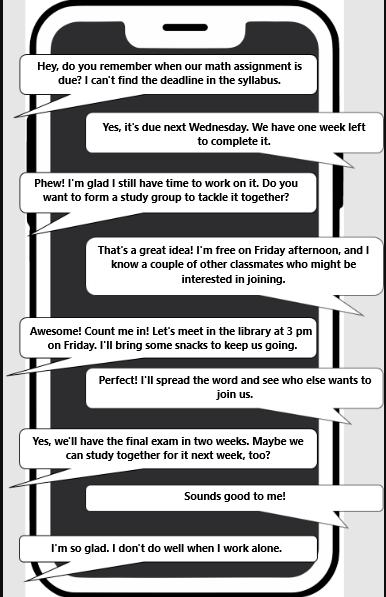
You are studying at a senior high school in Victoria, Canada. Your classmate Kevin is sending you messages about an assignment.
(Wait two minutes for the customer to read silently.)
D_2
| 1. | When will the group meet to work on the math assignment? |
| a. | On Wednesday afternoon at 3 pm. |
| b. | On Friday afternoon at 3 pm. |
| c. | On Wednesday morning at 10 am. |
| d. | On Friday evening at 5 pm. |
| Answer: |
*add if needed
Tutor: Review the answer
(Compliment the customer)
(This is an example answer. As long as the customer’s answer answers the questions, it is correct.)
The answer is,
———
“b. The group will meet on Friday afternoon at 3 pm to work on the math assignment.”
———
Wonderful! Let’s move on to the next.
(Compliment the customer)
(This is an example answer. As long as the customer’s answer answers the questions, it is correct.)
The answer is,
———
“b. The group will meet on Friday afternoon at 3 pm to work on the math assignment.”
———
Wonderful! Let’s move on to the next.
| 2. | Which parts of the information make you think that? | |
| Answer: |
Tutor: Review the answer
(Compliment the customer)
(This is an example answer. As long as the customer’s answer answers the questions, it is correct.)
The answer is,
———
Looking at the dialogue, the group agrees to meet in the library on Friday at 3 pm. So, I think b. is the correct answer.
(Compliment the customer)
(This is an example answer. As long as the customer’s answer answers the questions, it is correct.)
The answer is,
———
Looking at the dialogue, the group agrees to meet in the library on Friday at 3 pm. So, I think b. is the correct answer.
———
Part E Reading the Discussion & Sharing Your Opinion
E_1
Two people are having a conversation about a topic where they have differing opinions. Please read the entire dialogue aloud.
*differing opinions 異なる意見
*entire すべて
*entire すべて
(Make the customer read aloud the entire dialogue alone. Wait for the customer to finish reading.)

E_2
|
Harry
|
Hey, Roland. Have you started preparing for the math test? |
|
Roland
|
Not really. I’ll study the night before. |
|
Harry
|
Don’t you think it’s better to start at least five days earlier? |
|
Roland
|
I get that, but cramming works best for me. It helps me remember things better. Plus, I don’t want to lose sleep over several nights. |
|
Harry
|
I see, but I prefer studying little by little. It keeps the lessons fresh in my mind and helps me feel more organized. |
|
Roland
|
That makes sense, but I like taking notes first and then reviewing everything in one go. It keeps me focused. |
|
Harry
|
That’s true. In the end, giving full attention while studying is the most important thing. |
|
Roland
|
Agreed! Let’s both do our best to pass the test. |
|
Harry
|
Good luck! |
|
Roland
|
Thanks! Same to you! |
E_3
| 1. | What are they talking about? | |
| Answer: |
Tutor: Review the answer
(Compliment the customer)
(This is an example answer. As long as the customer’s answer answers the questions, it is correct.)
The answer is,
———
They are talking about preparing for a math test.
———
(Compliment the customer)
(This is an example answer. As long as the customer’s answer answers the questions, it is correct.)
The answer is,
———
They are talking about preparing for a math test.
———
| 2. | Between Harry and Roland, who agrees and who disagrees with starting to study earlier? | |
| Agree: | ||
| Disagree: |
Tutor: Review the answer
(Compliment the customer)
(This is an example answer. As long as the customer’s answer answers the questions, it is correct.)
The answer is,
———
Harry agrees with starting to study earlier.
Roland disagrees with starting to study earlier.
(Compliment the customer)
(This is an example answer. As long as the customer’s answer answers the questions, it is correct.)
The answer is,
———
Harry agrees with starting to study earlier.
Roland disagrees with starting to study earlier.
———
| 3. | What is one of the opinions in the conversation that agrees with Harry’s study method? |
| Answer: |
Tutor: Review the answer
(Compliment the customer)
(This is an example answer. As long as the customer’s answer answers the questions, it is correct.)
The answer is,
———
Studying little by little keeps the lessons fresh in the mind and helps with organization.
———
(Compliment the customer)
(This is an example answer. As long as the customer’s answer answers the questions, it is correct.)
The answer is,
———
Studying little by little keeps the lessons fresh in the mind and helps with organization.
———
| 4. | What is one of the opinions in the conversation that disagrees with Harry’s study method? | |
| Answer: |
Tutor: Review the answer
(Compliment the customer)
(This is an example answer. As long as the customer’s answer answers the questions, it is correct.)
The answer is,
———
Cramming works best because it helps with remembering things better and avoids losing sleep over several nights.
———
(Compliment the customer)
(This is an example answer. As long as the customer’s answer answers the questions, it is correct.)
The answer is,
———
Cramming works best because it helps with remembering things better and avoids losing sleep over several nights.
———
| 5. | If you agree with Harry’s study method, what do you think is a good point? | |
| Answer: |
Example:
insert hint if needed
insert hint if needed
insert hint if needed
insert hint if needed
Tutor: Review the answer
(Compliment the customer)
(Any customer’s answer(s) is/are correct.)
(Compliment the customer)
(Any customer’s answer(s) is/are correct.)
| 6. | If you disagree with Harry’s study method, what do you think is a bad point? | |
| Answer: |
Example:
insert hint if needed
insert hint if needed
insert hint if needed
insert hint if needed
Tutor: Review the answer
(Compliment the customer)
(Any customer’s answer(s) is/are correct.)
(Compliment the customer)
(Any customer’s answer(s) is/are correct.)
| 7. | Finally, please tell me your own opinion. Do you agree or disagree with Harry’s study method? |
| Answer: |
I agree. / I disagree. Because ____________________________________. |
Tutor: Review the answer
(Compliment the customer)
(Any customer’s answer(s) is/are correct.)
(Compliment the customer)
(Any customer’s answer(s) is/are correct.)
Part F Free Talk
F_1
Let’s do a free talk about the following topics.
(Please do a free talk if you have time left.)

F_2
|
Do you like studying every day, or do you prefer to study at the last minute? Why? How do you feel when you study the night before a test? Does it help you? What is one thing you do every day to stay organized? |
F_3
| Answer: |
応用トレーニング – Applied Training
Intermediate – Lesson 7
TUTORS NOTE
– OPEN the tutor guide URL in the Pinned Message.
– Follow the instructions in the tutor guide, which are in red font.
– Follow the instructions in the tutor guide, which are in red font.
Part A Listening
TUTORS NOTE
– OPEN the tutor guide URL in the Pinned message.
– Follow the instructions in [PART A_1] and [PART A_2] of the tutor guide, which are in red font.
– Follow the instructions in [PART A_1] and [PART A_2] of the tutor guide, which are in red font.
A_1
I will read a passage once. Choose the most appropriate answer to the question. Please listen carefully.
(Read aloud the script in [PART A_1] of the tutor guide, which is in red font.)
A_2
What is Kate trying to do?
| a. | She is trying to buy a new umbrella at the train station. |
| b. | She is trying to get her lost umbrella back from the lost and found. |
| c. | She is attempting to contact the train staff about her umbrella. |
| d. | She is looking to identify her missing umbrella. |
| Answer: |
Part B Listening & Description Practice
TUTORS NOTE
– OPEN the tutor guide URL in the Pinned message.
– Follow the instructions in [PART B_2] , [PART B_3] and [PART B_4] of the tutor guide, which are in red font.
– Follow the instructions in [PART B_2] , [PART B_3] and [PART B_4] of the tutor guide, which are in red font.
B_1
Look at the four similar pictures below. Please answer the questions about the differences between the pictures.
*similar 似ている
*difference 違い
*difference 違い
B_2
| 1. | Look at pictures 1 and 3. What is the difference between pictures 1 and 3? |
| Answer: |
*add if needed
| 2. | Look at pictures 2 and 4. What is the difference between pictures 2 and 4? |
| Answer: |
B_3
| 3. | I will read the script aloud. Which picture matches the script? Please listen carefully. |
(Read aloud the script in [PART B_3] of the tutor guide, which is in red font.)
B_4
| 3. | Which picture matches the script? |
| Answer: | |
| 4. | Why did you choose that picture? Please tell me the reason and describe the picture you chose. |
| Answer: |
Part C Reading a Graph
TUTORS NOTE
– OPEN the tutor guide URL in the Pinned message.
– Follow the instructions in [PART C_2] of the tutor guide, which are in red font.
– Follow the instructions in [PART C_2] of the tutor guide, which are in red font.
C_1
Look at the graph and the pie chart below. They show information about plastic bags and home appliances. What can you understand from these pictures? Please read the information quietly for one minute.
The graph shows the amount of waste from plastic bags over the years. The numbers on the left show the amount in tons. The years are shown along the bottom.
The second picture is a pie chart. It shows how much carbon dioxide is produced by different home appliances.
The graph shows the amount of waste from plastic bags over the years. The numbers on the left show the amount in tons. The years are shown along the bottom.
The second picture is a pie chart. It shows how much carbon dioxide is produced by different home appliances.
(Wait one minute for the customer to read silently.)

C_2
| 1. | In which year was the most waste from plastic bags? | |
| Answer: | ||
| 2. | Which home appliance produced the most carbon dioxide according to the pie chart? | |
| Answer: | ||
| 3. | Based on your answers to 1 and 2, explain what you can see in the graph and the pie chart. | |
| Answer: |
Part D Reading Information
TUTORS NOTE
– OPEN the tutor guide URL in the Pinned message.
– Follow the instructions in [PART D_2] of the tutor guide, which are in red font.
– Follow the instructions in [PART D_2] of the tutor guide, which are in red font.
D_1
You are studying at a senior high school in Victoria, Canada. Your classmate Kevin is sending you messages about an assignment.
(Wait two minutes for the customer to read silently.)

D_2
| 1. | When will the group meet to work on the math assignment? |
| a. | On Wednesday afternoon at 3 pm. |
| b. | On Friday afternoon at 3 pm. |
| c. | On Wednesday morning at 10 am. |
| d. | On Friday evening at 5 pm. |
| Answer: |
add if needed
| 2. | Which parts of the information make you think that? |
| Answer: |
Part E Reading the Discussion & Sharing Your Opinion
TUTORS NOTE
– OPEN the tutor guide URL in the Pinned message.
– Follow the instructions in [PART E_3] of the tutor guide, which are in red font.
– Follow the instructions in [PART E_3] of the tutor guide, which are in red font.
E_1
Two people are having a conversation about a topic where they have differing opinions. Please read the entire dialogue aloud.
*differing opinions 異なる意見
*entire すべて
*entire すべて
(Make the customer read aloud the entire dialogue alone. Wait for the customer to finish reading.)

E_2
|
Harry
|
Hey, Roland. Have you started preparing for the math test? |
|
Roland
|
Not really. I’ll study the night before. |
|
Harry
|
Don’t you think it’s better to start at least five days earlier? |
|
Roland
|
I get that, but cramming works best for me. It helps me remember things better. Plus, I don’t want to lose sleep over several nights. |
|
Harry
|
I see, but I prefer studying little by little. It keeps the lessons fresh in my mind and helps me feel more organized. |
|
Roland
|
That makes sense, but I like taking notes first and then reviewing everything in one go. It keeps me focused. |
|
Harry
|
That’s true. In the end, giving full attention while studying is the most important thing. |
|
Roland
|
Agreed! Let’s both do our best to pass the test. |
|
Harry
|
Good luck! |
|
Roland
| Thanks! Same to you! |
E_3
| 1. | What are they talking about? |
| Answer: | |
| 2. | Between Harry and Roland, who agrees and who disagrees with starting to study earlier? |
| Agree: | |
| Disagree: | |
| 3. | What is one of the opinions in the conversation that agrees with Harry’s study method? |
| Answer: | ||
| 4. | What is one of the opinions in the conversation that disagrees with Harry’s study method? | |
| Answer: | ||
| 5. | If you agree with Harry’s study method, what do you think is a good point? | |
| Answer: |
Example:
– add if needed
– add if needed
– add if needed
– add if needed
| 6. | If you disagree with Harry’s study method, what do you think is a bad point? | |
| Answer: |
Example:
– add if needed
– add if needed
– add if needed
– add if needed
| 7. | Finally, please tell me your own opinion. Do you agree or disagree with Harry’s study method? | |
| Answer: | I agree. / I disagree. Because ____________________________________. |
Part F Free Talk
F_1
Let’s do a free talk about the following topics.
(Please do a free talk if you have time left.)
F_2
|
Do you like studying every day, or do you prefer to study at the last minute? Why? How do you feel when you study the night before a test? Does it help you? What is one thing you do every day to stay organized? |
F_3
| Answer: |
Applied Training
【Tutor Guide】Beginner – Lesson 7
応用トレーニング – Applied Training
Beginner – Lesson 7

TUTORS NOTE
– OPEN the tutor guide URL in the Pinned Message.
– Follow the instructions in the tutor guide, which are in red font.
– Follow the instructions in the tutor guide, which are in red font.
Part A Listening
TUTORS NOTE
– OPEN the tutor guide URL in the Pinned message.
– Follow the instructions in [PART A_1] and [PART A_2] of the tutor guide, which are in red font.
– Follow the instructions in [PART A_1] and [PART A_2] of the tutor guide, which are in red font.
A_1
I will read a passage once. Choose the most appropriate answer to the question. Please listen carefully.
(Read aloud the script in [PART A_1] of the tutor guide, which is in red font.)
Hints
|
left – 忘れた umbrella – かさ Lost and Found Staff Member – 落とし物係スタッフ |
A_2
What is Kate trying to do?
| a. | She is trying to buy a new umbrella at the train station. |
| b. | She is trying to get her lost umbrella back from the lost and found. |
| c. | She is attempting to contact the train staff about her umbrella. |
| d. | She is looking to identify her missing umbrella. |
| Answer: |
Hints
|
attempting 試みている contact 連絡する identify 見分ける/識別する |
Part B Listening & Description Practice
TUTORS NOTE
– OPEN the tutor guide URL in the Pinned message.
– Follow the instructions in [PART B_2] , [PART B_3] and [PART B_4] of the tutor guide, which are in red font.
– Follow the instructions in [PART B_2] , [PART B_3] and [PART B_4] of the tutor guide, which are in red font.
B_1
Look at the four similar pictures below. Please answer the questions about the differences between the pictures.
*similar 似ている
*difference 違い
*difference 違い
B_2
| 1. | Look at pictures 1 and 3. What is the difference between pictures 1 and 3? |
| Answer: | The difference between pictures 1 and 3 is the ______. In picture 1, it’s ______. In picture 3, it’s ______. |
*insert if needed(change accordingly)
| 2. | Look at pictures 2 and 4. What is the difference between pictures 2 and 4? |
| Answer: | The difference between pictures 2 and 4 is the ______. In picture 2, there isn’t a ______. In picture 4, there is a ______. |
B_3
| 3. | I will read the script aloud. Which picture matches the script? Please listen carefully. |
(Read aloud the script in [PART B_3] of the tutor guide, which is in red font.)
B_4
| 3. | Which picture matches the script? |
| Answer: | I think picture ___ matches the script. |
| 4. | Why did you choose that picture? Please tell me the reason and describe the picture you chose. |
| Answer: | I chose picture ______ for two reasons. First, the boy is resting under a ______. Second, it started to ______. Only picture ___ matches the script. |
Part C Reading a Graph
TUTORS NOTE
– OPEN the tutor guide URL in the Pinned message.
– Follow the instructions in [PART C_2] of the tutor guide, which are in red font.
– Follow the instructions in [PART C_2] of the tutor guide, which are in red font.
C_1
Look at the graph and the pie chart below. They show information about plastic bags and home appliances. What can you understand from these pictures? Please read the information quietly for one minute.
The graph shows the amount of waste from plastic bags over the years. The numbers on the left show the amount in tons. The years are shown along the bottom.
The second picture is a pie chart. It shows how much carbon dioxide is produced by different home appliances.
The graph shows the amount of waste from plastic bags over the years. The numbers on the left show the amount in tons. The years are shown along the bottom.
The second picture is a pie chart. It shows how much carbon dioxide is produced by different home appliances.
(Wait for one minute for the customer to read silently.)
Hints
|
plastic bags レジ袋 home appliances 家庭用電化製品 amount 量 waste 廃棄物 tons トン produced 生み出された/発生した carbon dioxide 二酸化炭素 |
C_2
| 1. | In which year was the most waste from plastic bags? |
| Answer: | In ______, the waste from plastic bags was the highest at 17,000 tons. |
| 2. | Which home appliance produced the most carbon dioxide according to the pie chart? |
| Answer: | According to the pie chart, ______ produced the most carbon dioxide at 34%. |
| 3. | Based on your answers to 1 and 2, explain what you can see in the graph and the pie chart. |
| Answer: | The graph and the pie chart show that both plastic bags and ____________ like TVs have a big impact on the environment. The amount of ____________ waste has increased over time, and home appliances produce a lot of carbon dioxide, which is bad for the environment. |
Part D Reading Information
TUTORS NOTE
– OPEN the tutor guide URL in the Pinned message.
– Follow the instructions in [PART D_2] of the tutor guide, which are in red font.
– Follow the instructions in [PART D_2] of the tutor guide, which are in red font.
D_1
You are studying at a senior high school in Victoria, Canada. Your classmate Kevin is sending you messages about an assignment.
(Wait two minutes for the customer to read silently.)
Hints
| assignment | 課題/宿題 |
D_2
| 1. | When will the group meet to work on the math assignment? |
| a. | On Wednesday afternoon at 3 pm. |
| b. | On Friday afternoon at 3 pm. |
| c. | On Wednesday morning at 10 am. |
| d. | On Friday evening at 5 pm. |
| Answer: |
| 2. | Which parts of the information make you think that? |
| Answer: | Looking at the dialogue, the group agrees to meet in the library on ______ at ______. So, I think ______ is the correct answer. |
Part E Reading the Discussion & Your Opinion
TUTORS NOTE
– OPEN the tutor guide URL in the Pinned message.
– Follow the instructions in [PART E_3] of the tutor guide, which are in red font.
– Follow the instructions in [PART E_3] of the tutor guide, which are in red font.
E_1
Two people are having a conversation about a topic where they have differing opinions. Please read the entire dialogue aloud.
*differing opinions 異なる意見
*entire すべて
*entire すべて
(Make the customer read aloud the entire dialogue alone. Wait for the customer to finish reading.)
E_2
|
Harry
|
Hey, Roland. Have you started preparing for the math test? |
|
Roland
|
Not really. I’ll study the night before. |
|
Harry
|
Don’t you think it’s better to start at least five days earlier? |
|
Roland
|
I get that, but cramming works best for me. It helps me remember things better. Plus, I don’t want to lose sleep over several nights. |
|
Harry
|
I see, but I prefer studying little by little. It keeps the lessons fresh in my mind and helps me feel more organized. |
|
Roland
|
That makes sense, but I like taking notes first and then reviewing everything in one go. It keeps me focused. |
|
Harry
|
That’s true. In the end, giving full attention while studying is the most important thing. |
|
Roland
|
Agreed! Let’s both do our best to pass the test. |
|
Harry
|
Good luck! |
|
Roland
|
Thanks! Same to you! |
preparing 準備すること
cramming 一夜漬け
lose sleep 眠れなくなる/睡眠を失う
prefer ~のほうを好む
organized 整理された/計画的な
reviewing 復習すること
focused 集中した
luck 幸運
in one go 一度に
E_3
| 1. | What are they talking about? | |
| Answer: | They are talking about ___________. | |
| 2. | Between Harry and Roland, who agrees and who disagrees with starting to study earlier? | |
| Agree: | ______ agrees with starting to study earlier. | |
| Disagree: | ______ disagrees with starting to study earlier. | |
| 3. | What is one of the opinions in the conversation that agrees with Harry’s study method? |
| Answer: | ______ keeps the lessons fresh in the mind and helps with organization. |
| 4. | What is one of the opinions in the conversation that disagrees with Harry’s study method? |
| Answer: | ______ works best because it helps with remembering things better and avoids losing sleep over several nights. |
| 5. | If you agree with Harry’s study method, what do you think is a good point? |
| Answer: | I think ____________________ is a good point. |
Example:
– keeping the lessons fresh in your mind
– feeling more organized
– keeping the lessons fresh in your mind
– feeling more organized
| 6. | If you disagree with Roland’s study method, what do you think is a bad point? | |
| Answer: | I think ____________________ is a bad point. |
Example:
– losing sleep before the test
– forgetting things quickly after the test
– losing sleep before the test
– forgetting things quickly after the test
| 7. | Finally, please tell me your own opinion. Do you agree or disagree with Harry’s study method? | |
| Answer: | I agree. / I disagree. Because ____________________________________. |
Part F Free Talk
F_1
Let’s do a free talk about the following topics.
(Please do a free talk if you have time left.)
F_2
|
Do you like studying every day, or do you prefer to study at the last minute? Why? How do you feel when you study the night before a test? Does it help you? What is one thing you do every day to stay organized? |
F_3
| Answer: |
応用トレーニング – Applied Training
Intermediate – Lesson 6
TUTORS NOTE
– OPEN the tutor guide URL in the Pinned Message.
– Follow the instructions in the tutor guide, which are in red font.
– Follow the instructions in the tutor guide, which are in red font.
Part A Listening
TUTORS NOTE
– OPEN the tutor guide URL in the Pinned message.
– Follow the instructions in [PART A_1] and [PART A_2] of the tutor guide, which are in red font.
– Follow the instructions in [PART A_1] and [PART A_2] of the tutor guide, which are in red font.
A_1
I will read a passage once. Choose the most appropriate answer to the question. Please listen carefully.
(Read aloud the script in [PART A_1] the tutor guide, which is in red font.)
A_2
What did the aunt do at the concert?
| a. | She was nervous but watched the performance. |
| b. | She brought flowers and gave encouraging words. |
| c. | She was proud and took photos at the concert. |
| d. | She brought flowers and then went home. |
| Answer: |
Part B Listening & Description Practice
TUTORS NOTE
– OPEN the tutor guide URL in the Pinned message.
– Follow the instructions in [PART B_2] , [PART B_3] and [PART B_4] of the tutor guide, which are in red font.
– Follow the instructions in [PART B_2] , [PART B_3] and [PART B_4] of the tutor guide, which are in red font.
B_1
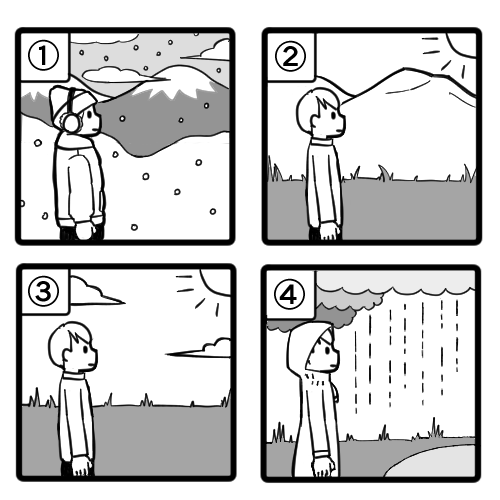
Look at the four similar pictures below. Please answer the questions about the differences between the pictures.
*similar 似ている
*difference 違い
*difference 違い
B_2
| 1. | Look at pictures 1 and 4. What is the difference between pictures 1 and 4? |
| Answer: |
*add if needed
| 2. | Look at pictures 2 and 3. What is the difference between pictures 2 and 3? |
| Answer: |
B_3
| 3. | I will read the script aloud. Which picture matches the script? Please listen carefully. |
(Read aloud the script in [PART B_3] the tutor guide, which is in red font.)
B_4
| 3. | Which picture matches the script? |
| Answer: | |
| 4. | Why did you choose that picture? Please tell me the reason and describe the picture you chose. |
| Answer: |
Part C Reading a Graph
TUTORS NOTE
– OPEN the tutor guide URL in the Pinned message.
– Follow the instructions in [PART C_2] of the tutor guide, which are in red font.
– Follow the instructions in [PART C_2] of the tutor guide, which are in red font.
C_1
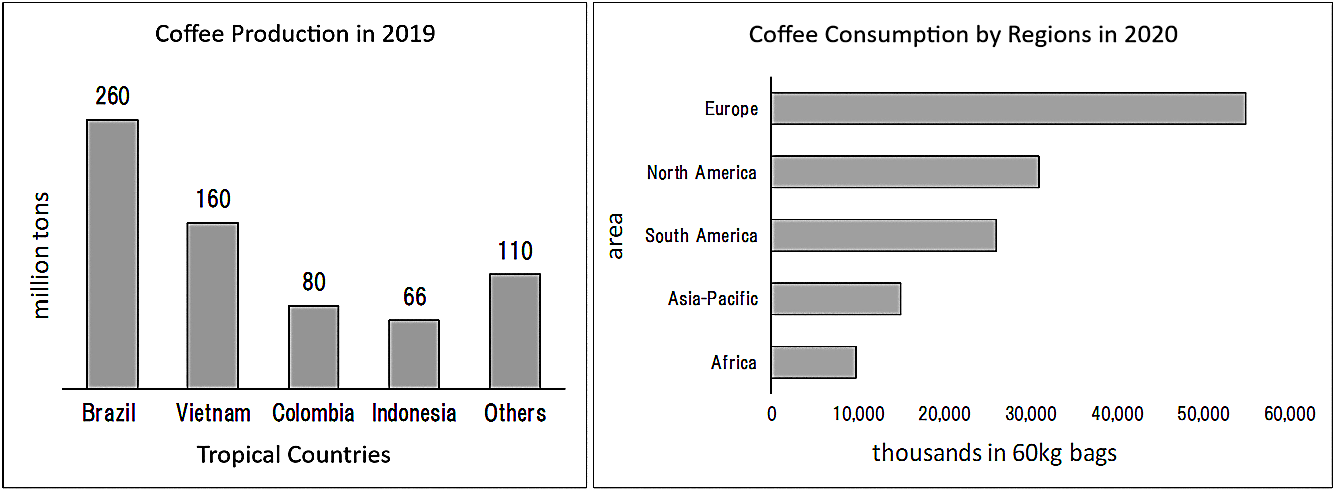
Look at the graphs below. The graph on the left shows coffee production in 2019, while the graph on the right shows coffee consumption by region in 2020. What can we learn from these graphs? Please read the information silently. I will give you one minute to read.
(Wait for one minute for the customer to read silently.)
C_2
| 1. | Which country had the highest coffee production in 2019? | |
| Answer: | ||
| 2. | Which region consumed the most coffee in 2020? | |
| Answer: | ||
| 3. | Based on your answers to 1 and 2, explain what you can see in the graph. | |
| Answer: |
Part D Reading Information
TUTORS NOTE
– OPEN the tutor guide URL in the Pinned message.
– Follow the instructions in [PART D_2] of the tutor guide, which are in red font.
– Follow the instructions in [PART D_2] of the tutor guide, which are in red font.
D_1
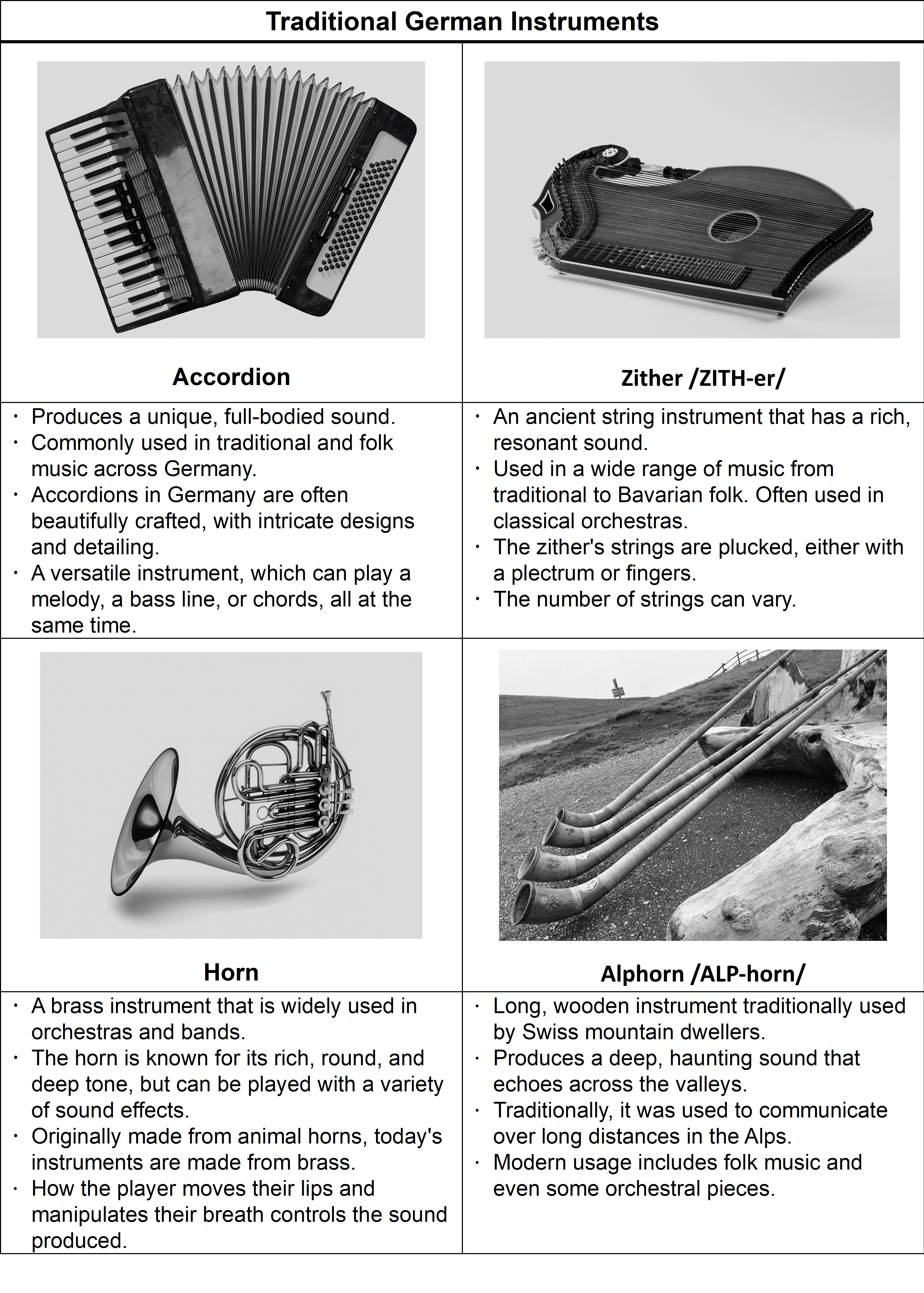
You are studying about Germany in the international club at your senior high school. Your teacher has asked you to do research on musical instruments in Germany. You find a German music guide and read about the instruments used in traditional music.
(Wait for one minute for the customer to read silently.)
D_2
| 1. | Both the horn and the alphorn … |
| a. | are woodwind instruments with high-pitched sounds. |
| b. | are both brass instruments known for their deep tones. |
| c. | are string instruments used mainly in orchestras. |
| d. | produce a light, soft sound and are primarily used in folk music. |
| Answer: |
add if needed
| 2. | Which parts of the information make you think that? |
| Answer: |
Part E Reading the Discussion & Sharing Your Opinion
TUTORS NOTE
– OPEN the tutor guide URL in the Pinned message.
– Follow the instructions in [PART E_3] of the tutor guide, which are in red font.
– Follow the instructions in [PART E_3] of the tutor guide, which are in red font.
E_1
Two people are having a conversation about a topic where they have differing opinions. Please read the entire dialogue aloud.
*differing opinions 異なる意見
*entire すべて
*entire すべて
(Make the customer read aloud the entire dialogue alone. Wait for the customer to finish reading.)

E_2
|
Charles
|
Hey, Rica. Are you busy? |
|
Rica
|
Hmm… Yeah, a little. |
|
Charles
|
I see you’re still playing on your smartphone. It’s been hours! Maybe you should take a break. |
|
Rica
|
It’s how I relax. I don’t think it’s a problem. |
|
Charles
|
But you’ve been using it for too long! Your eyes and fingers must be tired by now. |
|
Rica
|
I think playing for five hours straight is not bad. |
|
Charles
|
But don’t you have other things to do? Have you finished your chores? |
|
Rica
|
I know, but I’ve had a tough day. Adding an hour to my smartphone usage won’t hurt. |
|
Charles
|
It can become a bad habit, though. It’s important to balance your time. |
|
Rica
|
I guess you’re right. Maybe I’ll take a short break. |
E_3
| 1. | What are they talking about? |
| Answer: | |
| 2. | Between Charles and Rica, who agrees and who disagrees with the topic? |
| Agree: | |
| Disagree: | |
| 3. | What is one of the opinions in the conversation that agrees with the topic? |
| Answer: | ||
| 4. | What is one of the opinions in the conversation that disagrees with the topic? | |
| Answer: | ||
| 5. | If you agree with the topic, what do you think is a good point? | |
| Answer: |
Example:
– add if needed
– add if needed
– add if needed
– add if needed
| 6. | If you disagree with the topic, what do you think is a bad point? | |
| Answer: |
Example:
– add if needed
– add if needed
– add if needed
– add if needed
| 7. | Finally, please share your opinion. Do you agree or disagree that using a smartphone for long periods of time has no harmful effects? | |
| Answer: | I agree. / I disagree. Because ____________________________________. |
Part F Free Talk
F_1
Let’s do a free talk about the following topics.
(Please do a free talk if you have time left.)

F_2
|
What social media platform do you find most useful, and why? How many hours do you spend on social media each day? Do you ever try to limit your time on social media? Why or why not? |
F_3
| Answer: |
Applied Training
【Tutor Guide】Intermediate – Lesson 6
TUTORS NOTE
!!! This is the TUTOR GUIDE for customized material for Exam Prep INTERMEDIATE LESSON 6 !!!
– Follow the instructions in all parts, which are in red font.
Part A Listening
A_1
I will read a passage once. Choose the most appropriate answer to the question. Please listen carefully.
Read the script aloud once.
(Script)
I have played the piano since I was a child. One of my happiest memories is of a concert when I was twelve. I was very nervous, but my aunt Mary came to see me. She brought me flowers and said, “It’s okay to feel nervous—enjoy it!” Thanks to her, I played well. After the concert, we enjoyed a lovely dinner together.
A_2
What did the aunt do at the concert?
| a. | She was nervous but watched the performance. |
| b. | She brought flowers and gave encouraging words. |
| c. | She was proud and took photos at the concert. |
| d. | She brought flowers and then went home. |
| Answer: |
Tutor: Review the answer
(Compliment the customer)
The answer is “b. She brought flowers and gave encouraging words.”
Please read aloud the answer sentence(s).
Good job! Let’s move on to the next.
Part B Listening & Description Practice
B_1
Look at the four similar pictures below. Please answer the questions about the differences between the pictures.
*similar 似ている
*difference 違い
*difference 違い
B_2
| 1. | Look at pictures 1 and 4. What is the difference between pictures 1 and 4? | |
| Answer: |
Tutor: Review the answer
(Compliment the customer)
(This is an example answer. As long as the customer’s answer answers the questions, it is correct.)
The answer is,
———
The difference between pictures 1 and 4 is the weather.
(Compliment the customer)
(This is an example answer. As long as the customer’s answer answers the questions, it is correct.)
The answer is,
———
The difference between pictures 1 and 4 is the weather.
———
Wonderful! Let’s move on to the next.
| 2. | Look at pictures 2 and 3. What is the difference between pictures 2 and 3? | |
| Answer: |
Tutor: Review the answer
(Compliment the customer)
(This is an example answer. As long as the customer’s answer answers the questions, it is correct.)
The answer is,
———
The difference between pictures 2 and 3 is the mountain.
(Compliment the customer)
(This is an example answer. As long as the customer’s answer answers the questions, it is correct.)
The answer is,
———
The difference between pictures 2 and 3 is the mountain.
———
B_3
I will read the script aloud. Which picture matches the script? Please listen carefully.
Read aloud the script below once.
(Script) It’s cold and snowy today, but we can see the mountain over there. It’s beautiful!

B_4
| 3. | Which picture matches the script? | |
| Answer: |
Tutor: Review the answer
(Compliment the customer)
(This is an example answer. As long as the customer’s answer answers the questions, it is correct.)
The answer is,
———
I think picture 1 matches the script.
———
(Compliment the customer)
(This is an example answer. As long as the customer’s answer answers the questions, it is correct.)
The answer is,
———
I think picture 1 matches the script.
———
| 4. | Why did you choose that picture? Please tell me the reason and describe the picture you chose. | |
| Answer: |
Tutor: Review the answer
(Compliment the customer)
(This is an example answer. As long as the customer’s answer answers the questions, it is correct.)
The answer is,
———
I chose picture 1 for two reasons.
First, the weather is snowy.
Second, the mountain is there.
(Compliment the customer)
(This is an example answer. As long as the customer’s answer answers the questions, it is correct.)
The answer is,
———
I chose picture 1 for two reasons.
First, the weather is snowy.
Second, the mountain is there.
———
Awesome! Let’s move on to the next.
Part C Reading a Graph
C_1
Look at the graphs below. The graph on the left shows coffee production in 2019, while the graph on the right shows coffee consumption by region in 2020. What can we learn from these graphs? Please read the information silently. I will give you one minute to read.
(Wait for one minute for the customer to read silently.)

C_2
| 1. | Which country had the highest coffee production in 2019? |
| Answer: |
Tutor: Review the answer
(Compliment the customer)
(This is an example answer. As long as the customer’s answer answers the questions, it is correct.)
The answer is,
———
Brazil had the highest coffee production in 2019, producing 260 million tons.
———
(Compliment the customer)
(This is an example answer. As long as the customer’s answer answers the questions, it is correct.)
The answer is,
———
Brazil had the highest coffee production in 2019, producing 260 million tons.
———
| 2. | Which region consumed the most coffee in 2020? | |
| Answer: |
Tutor: Review the answer
(Compliment the customer)
(This is an example answer. As long as the customer’s answer answers the questions, it is correct.)
The answer is,
———
Europe consumed the most coffee in 2020.
———
(Compliment the customer)
(This is an example answer. As long as the customer’s answer answers the questions, it is correct.)
The answer is,
———
Europe consumed the most coffee in 2020.
———
| 3. | Based on your answers to 1 and 2, explain what you can see in the graph. | |
| Answer: |
Tutor: Review the answer
(Compliment the customer)
(This is an example answer. As long as the customer’s answer answers the questions, it is correct.)
The answer is,
———
(Compliment the customer)
(This is an example answer. As long as the customer’s answer answers the questions, it is correct.)
The answer is,
———
The graphs show that coffee is mostly grown in tropical countries and mainly consumed in regions such as Europe, North America, South America, the Asia-Pacific, and Africa.
———
You did a great job reading and describing the graph!
Let’s move on to the next.
Part D Reading Information
D_1
You are studying about Germany in the international club at your senior high school. Your teacher has asked you to do research on musical instruments in Germany. You find a German music guide and read about the instruments used in traditional music.
(Wait for one minute for the customer to read silently.)

D_2
| 1. | Both the horn and the alphorn … |
| a. | are woodwind instruments with high-pitched sounds. |
| b. | are both brass instruments known for their deep tones. |
| c. | are string instruments used mainly in orchestras. |
| d. | produce a light, soft sound and are primarily used in folk music. |
| Answer: |
Tutor: Review the answer
(Compliment the customer)
(This is an example answer. As long as the customer’s answer answers the questions, it is correct.)
The answer is,
———
“b. Both the horn and the alphorn are brass instruments known for their deep tones.”
———
Wonderful! Let’s move on to the next.
(Compliment the customer)
(This is an example answer. As long as the customer’s answer answers the questions, it is correct.)
The answer is,
———
“b. Both the horn and the alphorn are brass instruments known for their deep tones.”
———
Wonderful! Let’s move on to the next.
| 2. | Which parts of the information make you think that? | |
| Answer: |
Tutor: Review the answer
(Compliment the customer)
(This is an example answer. As long as the customer’s answer answers the questions, it is correct.)
The answer is,
———
Looking at the details, the horn is described as a brass instrument and has a deep tone. The alphorn is described as producing a deep, haunting sound, which is similar to the deep tones of brass instruments. So, I think b is the correct answer.
(Compliment the customer)
(This is an example answer. As long as the customer’s answer answers the questions, it is correct.)
The answer is,
———
Looking at the details, the horn is described as a brass instrument and has a deep tone. The alphorn is described as producing a deep, haunting sound, which is similar to the deep tones of brass instruments. So, I think b is the correct answer.
———
Part E Reading the Discussion & Sharing Your Opinion
E_1
Two people are having a conversation about a topic where they have differing opinions. Please read the entire dialogue aloud.
*differing opinions 異なる意見
*entire すべて
*entire すべて
(Make the customer read aloud the entire dialogue alone. Wait for the customer to finish reading.)

E_2
|
Charles
|
Hey, Rica. Are you busy? |
|
Rica
|
Hmm… Yeah, a little. |
|
Charles
|
I see you’re still playing on your smartphone. It’s been hours! Maybe you should take a break. |
|
Rica
|
It’s how I relax. I don’t think it’s a problem. |
|
Charles
|
But you’ve been using it for too long! Your eyes and fingers must be tired by now. |
|
Rica
|
I think playing for five hours straight is not bad. |
|
Charles
|
But don’t you have other things to do? Have you finished your chores? |
|
Rica
|
I know, but I’ve had a tough day. Adding an hour to my smartphone usage won’t hurt. |
|
Charles
|
It can become a bad habit, though. It’s important to balance your time. |
|
Rica
|
I guess you’re right. Maybe I’ll take a short break. |
E_3
| 1. | What are they talking about? | |
| Answer: |
Tutor: Review the answer
(Compliment the customer)
(This is an example answer. As long as the customer’s answer answers the questions, it is correct.)
The answer is,
———
They are talking about smartphone usage.
———
(Compliment the customer)
(This is an example answer. As long as the customer’s answer answers the questions, it is correct.)
The answer is,
———
They are talking about smartphone usage.
———
| 2. | Between Charles and Rica, who agrees and who disagrees with the topic? | |
| Agree: | ||
| Disagree: |
Tutor: Review the answer
(Compliment the customer)
(This is an example answer. As long as the customer’s answer answers the questions, it is correct.)
The answer is,
———
Rica agrees with the topic.
Charles disagrees with the topic.
(Compliment the customer)
(This is an example answer. As long as the customer’s answer answers the questions, it is correct.)
The answer is,
———
Rica agrees with the topic.
Charles disagrees with the topic.
———
| 3. | What is one of the opinions in the conversation that agrees with the topic? |
| Answer: |
Tutor: Review the answer
(Compliment the customer)
(This is an example answer. As long as the customer’s answer answers the questions, it is correct.)
The answer is,
———
I think playing for five hours straight is not bad.
———
(Compliment the customer)
(This is an example answer. As long as the customer’s answer answers the questions, it is correct.)
The answer is,
———
I think playing for five hours straight is not bad.
———
| 4. | What is one of the opinions in the conversation that disagrees with the topic? | |
| Answer: |
Tutor: Review the answer
(Compliment the customer)
(This is an example answer. As long as the customer’s answer answers the questions, it is correct.)
The answer is,
———
It can become a bad habit, though
———
(Compliment the customer)
(This is an example answer. As long as the customer’s answer answers the questions, it is correct.)
The answer is,
———
It can become a bad habit, though
———
| 5. | If you agree with the topic, what do you think is a good point? | |
| Answer: |
Example:
insert hint if needed
insert hint if needed
insert hint if needed
insert hint if needed
Tutor: Review the answer
(Compliment the customer)
(Any customer’s answer(s) is/are correct.)
(Compliment the customer)
(Any customer’s answer(s) is/are correct.)
| 6. | If you disagree with the topic, what do you think is a bad point? | |
| Answer: |
Example:
insert hint if needed
insert hint if needed
insert hint if needed
insert hint if needed
Tutor: Review the answer
(Compliment the customer)
(Any customer’s answer(s) is/are correct.)
(Compliment the customer)
(Any customer’s answer(s) is/are correct.)
| 7. | Finally, please share your opinion. Do you agree or disagree that using a smartphone for long periods of time has no harmful effects? |
| Answer: |
I agree. / I disagree. Because ____________________________________. |
Tutor: Review the answer
(Compliment the customer)
(Any customer’s answer(s) is/are correct.)
(Compliment the customer)
(Any customer’s answer(s) is/are correct.)
Part F Free Talk
F_1
Let’s do a free talk about the following topics.
(Please do a free talk if you have time left.)
F_2
|
What social media platform do you find most useful, and why? How many hours do you spend on social media each day? Do you ever try to limit your time on social media? Why or why not? |
F_3
| Answer: |
応用トレーニング – Applied Training
Beginner – Lesson 6
TUTORS NOTE
– OPEN the tutor guide URL in the Pinned Message.
– Follow the instructions in the tutor guide, which are in red font.
– Follow the instructions in the tutor guide, which are in red font.
Part A Listening
TUTORS NOTE
– OPEN the tutor guide URL in the Pinned message.
– Follow the instructions in [PART A_1] and [PART A_2] in the tutor guide, which are in red font.
– Follow the instructions in [PART A_1] and [PART A_2] in the tutor guide, which are in red font.
A_1
I will read a passage once. Choose the most appropriate answer to the question. Please listen carefully.
(Read aloud the script in [PART A_1] the tutor guide, which is in red font.)
Hints
| memories | 思い出 |
| nervous | 緊張して |
| lovely | 素敵な |
A_2
What did the aunt do at the concert?
| a. | She was nervous but watched the performance. |
| b. | She brought flowers and gave encouraging words. |
| c. | She was proud and took photos at the concert. |
| d. | She brought flowers and then went home. |
| Answer: |
Hints
| performance | 演奏 |
| encouraging | 元気づける |
| proud | 誇らしげな |
Part B Listening & Description Practice
TUTORS NOTE
– OPEN the tutor guide URL in the Pinned message.
– Follow the instructions in [PART B_2] , [PART B_3] and [PART B_4] in the tutor guide, which are in red font.
– Follow the instructions in [PART B_2] , [PART B_3] and [PART B_4] in the tutor guide, which are in red font.
B_1
Look at the four similar pictures below. Please answer the questions about the differences between the pictures.
*similar 似ている
*difference 違い
*difference 違い
B_2
| 1. | Look at pictures 1 and 4. What is the difference between pictures 1 and 4? |
| Answer: | The difference between pictures 1 and 4 is the _______. In picture 1, the weather is ______. In picture 4, the weather is ______. |
*insert if needed(change accordingly)
| 2. | Look at pictures 2 and 3. What is the difference between pictures 2 and 3? |
| Answer: | The difference between pictures 2 and 3 is the ______. In picture 2, the mountain is ______. In picture 3, the mountain is ______. |
B_3
| 3. | I will read the script aloud. Which picture matches the script? Please listen carefully. |
(Read aloud the script in [PART B_3] the tutor guide, which is in red font.)
B_4
| 3. | Which picture matches the script? |
| Answer: | I think picture ___ matches the script. |
| 4. | Why did you choose that picture? Please tell me the reason and describe the picture you chose. |
| Answer: | I chose picture ___ for two reasons. First, the weather is ______. Second, the mountain is ______. |
Part C Reading a Graph
TUTORS NOTE
– OPEN the tutor guide URL in the Pinned message.
– Follow the instructions in [PART C_2] in the tutor guide, which are in red font.
– Follow the instructions in [PART C_2] in the tutor guide, which are in red font.
C_1
Look at the graphs below. The graph on the left shows coffee production in 2019, while the graph on the right shows coffee consumption by region in 2020. What can we learn from these graphs? Please read the information silently. I will give you one minute to read.
(Wait for one minute for the customer to read silently.)
Hints
| production | 生産 |
| consumption | 消費 |
| region | 地域 |
C_2
| 1. | Which country had the highest coffee production in 2019? |
| Answer: | _____ had the highest coffee production in 2019. |
| 2. | Which region consumed the most coffee in 2020? |
| Answer: | _____ consumed the most coffee in 2020. |
| 3. | Based on your answers to 1 and 2, explain what you can see in the graph. |
| Answer: | The graphs show that coffee is mostly grown in ______ and mainly consumed in ______ such as Europe, North America, South America, the Asia-Pacific, and Africa. |
Hints
| grown | 栽培される |
| consumed | 消費される |
Part D Reading Information
TUTORS NOTE
– OPEN the tutor guide URL in the Pinned message.
– Follow the instructions in [PART D_2] in the tutor guide, which are in red font.
– Follow the instructions in [PART D_2] in the tutor guide, which are in red font.
D_1
You are studying about Germany in the international club at your senior high school. Your teacher has asked you to do research on musical instruments in Germany. You find a German music guide and read about the instruments used in traditional music.
(Wait for two minutes for the customer to read silently.)
Hints
| research | 研究 |
| instruments | 楽器 |
| traditional | 伝統的な |
Hints
|
produce 生み出す unique 独特の full-bodied 濃厚な、力強い commonly 一般的に crafted 精巧に作られた intricate 複雑な、入り組んだ detailing 細部の仕上げ versatile 多才な、多用途の ancient 古代の resonant よく響く variety 多様性、種類 effects 効果 originally 元々は manipulate 操作する traditionally 伝統的に dwellers 住人 haunting 心に残る echoes 反響する communicate 通信する、伝える distance 距離 orchestral オーケストラの |
D_2
| 1. | Both the horn and the alphorn … |
| a. | are woodwind instruments with high-pitched sounds. |
| b. | are both brass instruments known for their deep tones. |
| c. | are string instruments used mainly in orchestras. |
| d. | produce a light, soft sound and are primarily used in folk music. |
| Answer: |
| 2. | Which parts of the information make you think that? |
| Answer: |
Looking at the details, the horn is described as a __________ and has a __________. The alphorn is described as producing a __________, which is similar to the deep tones of brass instruments. So, I think __________ is the correct answer. |
Part E Reading the Discussion & Your Opinion
TUTORS NOTE
– OPEN the tutor guide URL in the Pinned message.
– Follow the instructions in [PART E_3] in the tutor guide, which are in red font.
– Follow the instructions in [PART E_3] in the tutor guide, which are in red font.
E_1
Two people are having a conversation about a topic where they have differing opinions. Please read the entire dialogue aloud.
*differing opinions 異なる意見
*entire すべて
*entire すべて
(Make the customer read aloud the entire dialogue alone. Wait for the customer to finish reading.)
E_2
|
Charles
|
Hey, Rica. Are you busy? |
|
Rica
|
Hmm… Yeah, a little. |
|
Charles
|
I see you’re still playing on your smartphone. It’s been hours! Maybe you should take a break. |
|
Rica
|
It’s how I relax. I don’t think it’s a problem. |
|
Charles
|
But you’ve been using it for too long! Your eyes and fingers must be tired by now. |
|
Rica
|
I think playing for five hours straight is not bad. |
|
Charles
|
But don’t you have other things to do? Have you finished your chores? |
|
Rica
|
I know, but I’ve had a tough day. Adding an hour to my smartphone usage won’t hurt. |
|
Charles
|
It can become a bad habit, though. It’s important to balance your time. |
|
Rica
|
I guess you’re right. Maybe I’ll take a short break. |
straight 連続して
finished 終えた
chores 家事、雑用
tough つらい、大変な
usage 使用、使い方
habit 習慣
balance バランスをとる
guess 推測する、たぶんそう思う
E_3
| 1. | What are they talking about? | |
| Answer: | They are talking about ___________. | |
| 2. | Between Charles and Rica, who agrees and who disagrees with the topic? | |
| Agree: | _______ agrees with the topic. | |
| Disagree: | _______ disagrees with the topic. | |
| 3. | What is one of the opinions in the conversation that agrees with the topic? |
| Answer: | I think playing for five hours straight is __________. |
| 4. | What is one of the opinions in the conversation that disagrees with the topic? |
| Answer: | It can become a __________, though. |
| 5. | If you agree with the topic, what do you think is a good point? |
| Answer: | I think __________ a good point. |
Example:
– relaxing with a smartphone
– using it for fun after a hard day
– relaxing with a smartphone
– using it for fun after a hard day
| 6. | If you disagree with the topic, what do you think is a bad point? | |
| Answer: | I think __________ is a bad point. |
Example:
– getting tired eyes and hands
– spending too much time
– getting tired eyes and hands
– spending too much time
| 7. | Finally, please share your opinion. Do you agree or disagree that using a smartphone for long periods of time has no harmful effects? | |
| Answer: | I agree. / I disagree. Because ____________________________________. |
Part F Free Talk
F_1
Let’s do a free talk about the following topics.
(Please do a free talk if you have time left.)
F_2
|
What social media platform do you find most useful, and why? How many hours do you spend on social media each day? Do you ever try to limit your time on social media? Why or why not? |
F_3
| Answer: |
Applied Training
【Tutor Guide】Beginner – Lesson 6
TUTORS NOTE
!!! This is the TUTOR GUIDE for customized material for Exam Prep BEGINNER LESSON 6 !!!
– Follow the instructions in all parts, which are in red font.
Part A Listening
A_1
I will read a passage once. Choose the most appropriate answer to the question. Please listen carefully.
Read aloud the script below once.
(Script)
I have played the piano since I was a child. One of my happiest memories is of a concert when I was twelve. I was very nervous, but my aunt Mary came to see me. She brought me flowers and said, “It’s okay to feel nervous—enjoy it!” Thanks to her, I played well. After the concert, we enjoyed a lovely dinner together.
Hints
| (word1) | JP1 |
| (word2) | JP2 |
| (word3) | JP3 |
| (word4) | JP4 |
| (word5) | JP5 |
A_2
What did the aunt do at the concert?
| a. | She was nervous but watched the performance. |
| b. | She brought flowers and gave encouraging words. |
| c. | She was proud and took photos at the concert. |
| d. | She brought flowers and then went home. |
| Answer: |
Tutor: Review the answer
(Compliment the customer)
The answer is “b. She brought flowers and gave encouraging words.”
Please read aloud the answer sentence(s).
Good job! Let’s move on to the next.
Hints
| hint1 | JP1 | |
| hint2 | JP2 |
Part B Listening & Description Practice
B_1
Look at the four similar pictures below. Please answer the questions about the differences between the pictures.
*similar 似ている
*difference 違い
*difference 違い
Hints
| hint1 | JP1 | |
| hint2 | JP2 | |
| hint3 | JP3 |
B_2
| 1. | Look at pictures 1 and 4. What is the difference between pictures 1 and 4? |
| Answer: |
The difference between pictures 1 and 4 is the _______. In picture 1, the weather is ______. In picture 4, the weather is ______. |
Tutor: Review the answer
(Compliment the customer)
The answer is,
———
The difference between pictures 1 and 4 is the weather.
In picture 1, the weather is snowy.
In picture 4, the weather is rainy.
(Compliment the customer)
The answer is,
———
The difference between pictures 1 and 4 is the weather.
In picture 1, the weather is snowy.
In picture 4, the weather is rainy.
———
*(insert hint if needed)
| 2. | Look at pictures 2 and 3. What is the difference between pictures 2 and 3? |
| Answer: |
The difference between pictures 2 and 3 is the ______. In picture 2, the mountain is ______. In picture 3, the mountain is ______. |
Tutor: Review the answer
(Compliment the customer)
The answer is,
———
The difference between pictures 2 and 3 is the mountain.
In picture 2, the mountain is there.
In picture 3, the mountain is not there.
(Compliment the customer)
The answer is,
———
The difference between pictures 2 and 3 is the mountain.
In picture 2, the mountain is there.
In picture 3, the mountain is not there.
———
B_3
I will read the script aloud. Which picture matches the script? Please listen carefully.
Read aloud the script below once.
(Script) It’s cold and snowy today, but we can see the mountain over there. It’s beautiful!

B_4
| 3. | Which picture matches the script? |
| Answer: | I think picture ___ matches the script. |
Tutor: Review the answer
(Compliment the customer)
The answer is,
———
I think picture 1 matches the script.
———
(Compliment the customer)
The answer is,
———
I think picture 1 matches the script.
———
| 4. | Why did you choose that picture? Please tell me the reason and describe the picture you chose. |
| Answer: | I chose picture ___ for two reasons. First, the weather is ______. Second, the mountain is ______. |
Tutor: Review the answer
(Compliment the customer)
The answer is,
———
I chose picture 1 for two reasons.
First, the weather is snowy.
Second, the mountain is there.
(Compliment the customer)
The answer is,
———
I chose picture 1 for two reasons.
First, the weather is snowy.
Second, the mountain is there.
———
Awesome! Let’s move on to the next.
Part C Reading a Graph
C_1
Look at the graphs below. The graph on the left shows coffee production in 2019, while the graph on the right shows coffee consumption by region in 2020. What can we learn from these graphs? Please read the information silently. I will give you one minute to read.
(Wait for one minute for the customer to read silently.)
Hints
| hint1 | JP1 | |
| hint1 | JP1 | |
| hint2 | JP2 | |
| hint3 | JP3 |

Hints
hint1
hint2
hint3
hint4
hint5
hint2
hint3
hint4
hint5

C_2
| 1. | Which country had the highest coffee production in 2019? |
| Answer: |
_____ had the highest coffee production in 2019. |
Tutor: Review the answer
(Compliment the customer)
The answer is,
———
Brazil had the highest coffee production in 2019, producing 260 million tons.
———
(Compliment the customer)
The answer is,
———
Brazil had the highest coffee production in 2019, producing 260 million tons.
———
| 2. | Which region consumed the most coffee in 2020? |
| Answer: | _____ consumed the most coffee in 2020. |
Tutor: Review the answer
(Compliment the customer)
The answer is,
———
Europe consumed the most coffee in 2020.
———
(Compliment the customer)
The answer is,
———
Europe consumed the most coffee in 2020.
———
| 3. | Based on your answers to 1 and 2, explain what you can see in the graphs. |
| Answer: | The graphs show that coffee is mostly grown in ______ and mainly consumed in _______ such as Europe, North America, South America, the Asia-Pacific, and Africa. |
Tutor: Review the answer
(Compliment the customer)
The answer is,
———
(Compliment the customer)
The answer is,
———
The graphs show that coffee is mostly grown in tropical countries and mainly consumed in regions such as Europe, North America, South America, the Asia-Pacific, and Africa.
———
You did a great job reading and describing the graph!
Let’s move on to the next.
Hints
| hint1 | JP1 | |
| hint2 | JP2 |
Part D Reading Information
D_1
You are studying about Germany in the international club at your senior high school. Your teacher has asked you to do research on musical instruments in Germany. You find a German music guide and read about the instruments used in traditional music.
(Wait for two minutes for the customer to read silently.)
Hints
| hint1 | JP1 | |
| hint2 | JP2 | |
| hint3 | JP3 | |
| hint4 | JP4 | |
| hint5 | JP5 | |
| hint6 | JP6 |
Hints
| hint1 | JP1 | |
| hint2 | JP2 | |
| hint3 | JP3 | |
| hint4 | JP4 | |
| hint5 | JP5 | |
| hint6 | JP6 | |
| hint7 | JP7 |
D_2
| 1. | Both the horn and the alphorn … |
| a. | are woodwind instruments with high-pitched sounds. |
| b. | are both brass instruments known for their deep tones. |
| c. | are string instruments used mainly in orchestras. |
| d. | produce a light, soft sound and are primarily used in folk music. |
| Answer: |
add if needed
Tutor: Review the answer
(Compliment the customer)
The answer is,
———
“b. Both the horn and the alphorn are brass instruments known for their deep tones“.
———
Wonderful! Let’s move on to the next.
(Compliment the customer)
The answer is,
———
“b. Both the horn and the alphorn are brass instruments known for their deep tones“.
———
Wonderful! Let’s move on to the next.
| 2. | Which parts of the information make you think that? |
| Answer: |
Looking at the details, the horn is described as a __________ and has a __________. The alphorn is described as producing a __________, which is similar to the deep tones of brass instruments. So, I think __________ is the correct answer. |
Tutor: Review the answer
(Compliment the customer)
The answer is,
———
Looking at the details, the horn is described as a brass instrument and has a deep tone. The alphorn is described as producing a deep, haunting sound, which is similar to the deep tones of brass instruments.
So, I think b is the correct answer.
(Compliment the customer)
The answer is,
———
Looking at the details, the horn is described as a brass instrument and has a deep tone. The alphorn is described as producing a deep, haunting sound, which is similar to the deep tones of brass instruments.
So, I think b is the correct answer.
———
Part E Reading the Discussion & Your Opinion
E_1
Two people are having a conversation about a topic where they have differing opinions. Please read the entire dialogue aloud.
*differing opinions 異なる意見
*entire すべて
*entire すべて
(Make the customer read aloud the entire dialogue alone. Wait for the customer to finish reading.)
E_2
|
Charles
|
Hey, Rica. Are you busy? |
|
Rica
|
Hmm… Yeah, a little. |
|
Charles
|
I see you’re still playing on your smartphone. It’s been hours! Maybe you should take a break. |
|
Rica
|
It’s how I relax. I don’t think it’s a problem. |
|
Charles
|
But you’ve been using it for too long! Your eyes and fingers must be tired by now. |
|
Rica
|
I think playing for five hours straight is not bad. |
|
Charles
|
But don’t you have other things to do? Have you finished your chores? |
|
Rica
|
I know, but I’ve had a tough day. Adding an hour to my smartphone usage won’t hurt. |
|
Charles
|
It can become a bad habit, though. It’s important to balance your time. |
|
Rica
|
I guess you’re right. Maybe I’ll take a short break. |
hint1
hint2
hint3
hint4
hint5
hint6
hint7
hint8
hint9
E_3
| 1. | What are they talking about? |
| Answer: | They are talking about ___________. |
Tutor: Review the answer
(Compliment the customer)
The answer is,
———
They are talking about smartphone usage.
———
(Compliment the customer)
The answer is,
———
They are talking about smartphone usage.
———
| 2. | Between Charles and Rica, who agrees and who disagrees with the topic? |
| Agree: | _______ agrees with the topic. |
| Disagree: | _______ disagrees with the topic. |
Tutor: Review the answer
(Compliment the customer)
The answer is,
———
Rica agrees with the topic.
Charles disagrees with the topic.
(Compliment the customer)
The answer is,
———
Rica agrees with the topic.
Charles disagrees with the topic.
———
| 3. | What is one of the opinions in the conversation that agrees with the topic? |
| Answer: | I think playing for five hours straight is __________. |
Tutor: Review the answer
(Compliment the customer)
The answer is,
———
I think playing for five hours straight is not bad.
———
(Compliment the customer)
The answer is,
———
I think playing for five hours straight is not bad.
———
| 4. | What is one of the opinions in the conversation that disagrees with the topic? |
| Answer: | It can become a __________, though. |
Tutor: Review the answer
(Compliment the customer)
The answer is,
———
It can become a bad habit, though.
———
(Compliment the customer)
The answer is,
———
It can become a bad habit, though.
———
| 5. | If you agree with the topic, what do you think is a good point? |
| Answer: | I think __________ a good point. |
Example:
insert hint if needed
insert hint if needed
insert hint if needed
insert hint if needed
Tutor: Review the answer
(Compliment the customer)
The answer is,
(Any customer’s answer(s) is/are correct. Compliment the customer.)
(Compliment the customer)
The answer is,
(Any customer’s answer(s) is/are correct. Compliment the customer.)
| 6. | If you disagree with the topic, what do you think is a bad point? |
| Answer: | I think __________ is a bad point. |
Example:
insert hint if needed
insert hint if needed
insert hint if needed
insert hint if needed
Tutor: Review the answer
(Any customer’s answer(s) is/are correct. Compliment the customer.)
(Any customer’s answer(s) is/are correct. Compliment the customer.)
| 7. | Finally, please share your opinion. Do you agree or disagree that using a smartphone for long periods of time has no harmful effects? |
| Answer: |
I agree. / I disagree. Because ____________________________________. |
Tutor: Review the answer
(Any customer’s answer(s) is/are correct. Compliment the customer.)
(Any customer’s answer(s) is/are correct. Compliment the customer.)
Part F Free Talk
F_1
Let’s do a free talk about the following topics.
(Please do a free talk if you have time left.)
F_2
|
What social media platform do you find most useful, and why? How many hours do you spend on social media each day? Do you ever try to limit your time on social media? Why or why not? |
F_3
| Answer: |
Applied Training
【Tutor Guide】Intermediate – Lesson 5
TUTORS NOTE
!!! This is the TUTOR GUIDE for customized material for Exam Prep INTERMEDIATE LESSON 5 !!!
– Follow the instructions in all parts, which are in red font.
Part A Listening
A_1
I will read a passage once. Choose the most appropriate answer to the question. Please listen carefully.
Read the script aloud once.
(Script)
One afternoon on the train, a young man sat near me, busy with his smartphone and not paying attention to others. When the train stopped at the next station, he suddenly stood up, took a bag from the rack, and got off. After the doors closed, I saw him through the window, giving the bag to an elderly woman who forgot it.
A_2
What did the young man do after he got off the train?
| a. | He gave the bag to an elderly woman. |
| b. | He left the bag on the train. |
| c. | He gave the bag to another passenger. |
| d. | He took the bag home with him. |
| Answer: |
Tutor: Review the answer
(Compliment the customer)
The answer is “a. He gave the bag to an elderly woman. “
Please read aloud the answer sentence(s).
Good job! Let’s move on to the next.
Part B Listening & Description Practice
B_1
Look at the four similar pictures below. Please answer the questions about the differences between the pictures.
*similar 似ている
*difference 違い
*difference 違い
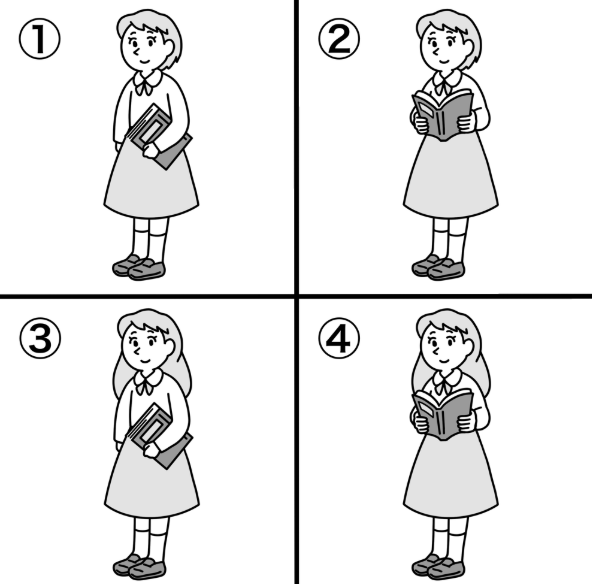
B_2
| 1. | Look at pictures 1 and 3. What is the difference between pictures 1 and 3? | |
| Answer: |
Tutor: Review the answer
(Compliment the customer)
(This is an example answer. As long as the customer’s answer answers the questions, it is correct.)
The answer is,
———
The difference between pictures 1 and 3 is the hair.
(Compliment the customer)
(This is an example answer. As long as the customer’s answer answers the questions, it is correct.)
The answer is,
———
The difference between pictures 1 and 3 is the hair.
———
Wonderful! Let’s move on to the next.
| 2. | Look at pictures 3 and 4. What is the difference between pictures 3 and 4? | |
| Answer: |
Tutor: Review the answer
(Compliment the customer)
(This is an example answer. As long as the customer’s answer answers the questions, it is correct.)
The answer is,
———
The difference between pictures 3 and 4 is the action.
(Compliment the customer)
(This is an example answer. As long as the customer’s answer answers the questions, it is correct.)
The answer is,
———
The difference between pictures 3 and 4 is the action.
———
B_3
I will read the script aloud. Which picture matches the script? Please listen carefully.
Read aloud the script below once.
(Script) The girl with long hair is Kathy. She is holding a book in her arm.

B_4
| 3. | Which picture matches the script? | |
| Answer: |
Tutor: Review the answer
(Compliment the customer)
(This is an example answer. As long as the customer’s answer answers the questions, it is correct.)
The answer is,
———
I think picture 3 matches the script.
———
(Compliment the customer)
(This is an example answer. As long as the customer’s answer answers the questions, it is correct.)
The answer is,
———
I think picture 3 matches the script.
———
| 4. | Why did you choose that picture? Please tell me the reason and describe the picture you chose. | |
| Answer: |
Tutor: Review the answer
(Compliment the customer)
(This is an example answer. As long as the customer’s answer answers the questions, it is correct.)
The answer is,
———
I chose picture 3 for two reasons.
First, the girl has long hair.
Second, she is holding a book in her arm.
(Compliment the customer)
(This is an example answer. As long as the customer’s answer answers the questions, it is correct.)
The answer is,
———
I chose picture 3 for two reasons.
First, the girl has long hair.
Second, she is holding a book in her arm.
———
Awesome! Let’s move on to the next.
Part C Reading a Graph
C_1
Look at the graph below. It shows how the number of internet users has changed over time. What can we learn from this graph? Please read the information silently. I will give you one minute to read.
The graph shows the number of internet users from 1990 to 2020. The X-axis shows the years. The Y-axis shows the number of internet users, starting from 100 million to 4 billion.
The graph shows the number of internet users from 1990 to 2020. The X-axis shows the years. The Y-axis shows the number of internet users, starting from 100 million to 4 billion.
(Wait for one minute for the customer to read silently.)
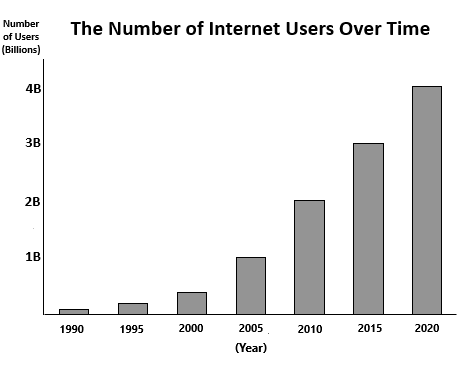
C_2
| 1. | In which year did the number of internet users reach 2 billion? |
| Answer: |
Tutor: Review the answer
(Compliment the customer)
(This is an example answer. As long as the customer’s answer answers the questions, it is correct.)
The answer is,
———
The number of internet users reached 2 billion in the year 2010.
———
(Compliment the customer)
(This is an example answer. As long as the customer’s answer answers the questions, it is correct.)
The answer is,
———
The number of internet users reached 2 billion in the year 2010.
———
| 2. | How many internet users were there in 2015? | |
| Answer: |
Tutor: Review the answer
(Compliment the customer)
(This is an example answer. As long as the customer’s answer answers the questions, it is correct.)
The answer is,
———
In 2015, there were 3 billion internet users.
———
(Compliment the customer)
(This is an example answer. As long as the customer’s answer answers the questions, it is correct.)
The answer is,
———
In 2015, there were 3 billion internet users.
———
| 3. | Based on your answers to 1 and 2, explain what you can see in the graph. | |
| Answer: |
Tutor: Review the answer
(Compliment the customer)
(This is an example answer. As long as the customer’s answer answers the questions, it is correct.)
The answer is,
———
(Compliment the customer)
(This is an example answer. As long as the customer’s answer answers the questions, it is correct.)
The answer is,
———
The graph shows that the number of internet users increased a lot from 2010 to 2015.
———
You did a great job reading and describing the graph!
Let’s move on to the next.
Part D Reading Information
D_1
You are a member of an international club at your school, and you plan to travel to European countries this summer. You have several options for places to visit during your trip.
(Wait for one minute for the customer to read silently.)

D_2
| 1. | Both the museum and the university … |
| a. | are free to visit and offer historical insights. |
| b. | have exhibits about Europe and are open until 9:00 pm. |
| c. | charge no admission and provide multilingual explanations. |
| d. | offer cultural performances and historical tours. |
| Answer: |
Tutor: Review the answer
(Compliment the customer)
(This is an example answer. As long as the customer’s answer answers the questions, it is correct.)
The answer is,
———
“a. Both the museum and the university are free to visit and offer historical insights.”
———
Wonderful! Let’s move on to the next.
(Compliment the customer)
(This is an example answer. As long as the customer’s answer answers the questions, it is correct.)
The answer is,
———
“a. Both the museum and the university are free to visit and offer historical insights.”
———
Wonderful! Let’s move on to the next.
| 2. | Which parts of the information make you think that? | |
| Answer: |
Tutor: Review the answer
(Compliment the customer)
(This is an example answer. As long as the customer’s answer answers the questions, it is correct.)
The answer is,
———
Looking at the hours and admission details, both the museum and the university are free to visit and offer historical insights. So, I think a is the correct answer.
(Compliment the customer)
(This is an example answer. As long as the customer’s answer answers the questions, it is correct.)
The answer is,
———
Looking at the hours and admission details, both the museum and the university are free to visit and offer historical insights. So, I think a is the correct answer.
———
Part E Reading the Discussion & Sharing Your Opinion
E_1
Two people are having a conversation about a topic where they have differing opinions. Please read the entire dialogue aloud.
*differing opinions 異なる意見
*entire すべて
*entire すべて
(Make the customer read aloud the entire dialogue alone. Wait for the customer to finish reading.)

E_2
|
Katy
|
Gab, do you have any plans for the weekend? |
|
Gab
|
I’m going mountain climbing with some friends on Saturday. Do you want to come? |
|
Katy
|
Thank you, but I’m staying at home. I’m not an outdoorsy person. |
|
Gab
|
You could make an exception. Climbing mountains is an incredible experience. You’re out in the open, surrounded by nature. Also, it’s good exercise. |
|
Katy
|
I’d rather just go to the gym if I want to exercise. It only takes an hour, and I feel pleasant and refreshed afterward. |
|
Gab
|
Yes, but the gym isn’t a real challenge. Climbing mountains forces you to push yourself to your limits. |
|
Katy
|
Maybe, but to me, it seems too unsafe. |
|
Gab
|
Not at all. Cars or even stairs injure way more people than mountains. |
|
Katy
|
I guess we’re different, then. |
|
Gab
|
That’s true. Anyway, I have to get ready now. See you next time! |
E_3
| 1. | What are they talking about? | |
| Answer: |
Tutor: Review the answer
(Compliment the customer)
(This is an example answer. As long as the customer’s answer answers the questions, it is correct.)
The answer is,
———
They are talking about mountain climbing.
———
(Compliment the customer)
(This is an example answer. As long as the customer’s answer answers the questions, it is correct.)
The answer is,
———
They are talking about mountain climbing.
———
| 2. | Between Katy and Gab, who agrees and who disagrees with the topic? | |
| Agree: | ||
| Disagree: |
Tutor: Review the answer
(Compliment the customer)
(This is an example answer. As long as the customer’s answer answers the questions, it is correct.)
The answer is,
———
Gab agrees with the topic.
Katy disagrees with the topic.
(Compliment the customer)
(This is an example answer. As long as the customer’s answer answers the questions, it is correct.)
The answer is,
———
Gab agrees with the topic.
Katy disagrees with the topic.
———
| 3. | What is one of the opinions in the conversation that agrees with the topic? |
| Answer: |
Tutor: Review the answer
(Compliment the customer)
(This is an example answer. As long as the customer’s answer answers the questions, it is correct.)
The answer is,
———
It is an incredible experience to climb mountains because you’re out in the open, surrounded by nature.
———
(Compliment the customer)
(This is an example answer. As long as the customer’s answer answers the questions, it is correct.)
The answer is,
———
It is an incredible experience to climb mountains because you’re out in the open, surrounded by nature.
———
| 4. | What is one of the opinions in the conversation that disagrees with the topic? | |
| Answer: |
Tutor: Review the answer
(Compliment the customer)
(This is an example answer. As long as the customer’s answer answers the questions, it is correct.)
The answer is,
———
Mountain climbing seems too unsafe.
———
(Compliment the customer)
(This is an example answer. As long as the customer’s answer answers the questions, it is correct.)
The answer is,
———
Mountain climbing seems too unsafe.
———
| 5. | If you agree with the topic, what do you think is a good point? | |
| Answer: |
Example:
insert hint if needed
insert hint if needed
insert hint if needed
insert hint if needed
Tutor: Review the answer
(Compliment the customer)
(Any customer’s answer(s) is/are correct.)
(Compliment the customer)
(Any customer’s answer(s) is/are correct.)
| 6. | If you disagree with the topic, what do you think is a bad point? | |
| Answer: |
Example:
insert hint if needed
insert hint if needed
insert hint if needed
insert hint if needed
Tutor: Review the answer
(Compliment the customer)
(Any customer’s answer(s) is/are correct.)
(Compliment the customer)
(Any customer’s answer(s) is/are correct.)
| 7. | Finally, please tell me your own opinion. Do you agree or disagree that mountain climbing is an incredible experience? |
| Answer: |
I agree. / I disagree. Because ____________________________________. |
Tutor: Review the answer
(Compliment the customer)
(Any customer’s answer(s) is/are correct.)
(Compliment the customer)
(Any customer’s answer(s) is/are correct.)
Part F Free Talk
F_1
Let’s do a free talk about the following topics.
(Please do a free talk if you have time left.)

F_2
|
Do you enjoy outdoor activities like mountain climbing or hiking? Why or why not? What is a challenging activity you have done recently? How did you feel about it? Have you ever faced a situation where you had to push yourself to your limits? |
F_3
| Answer: |